
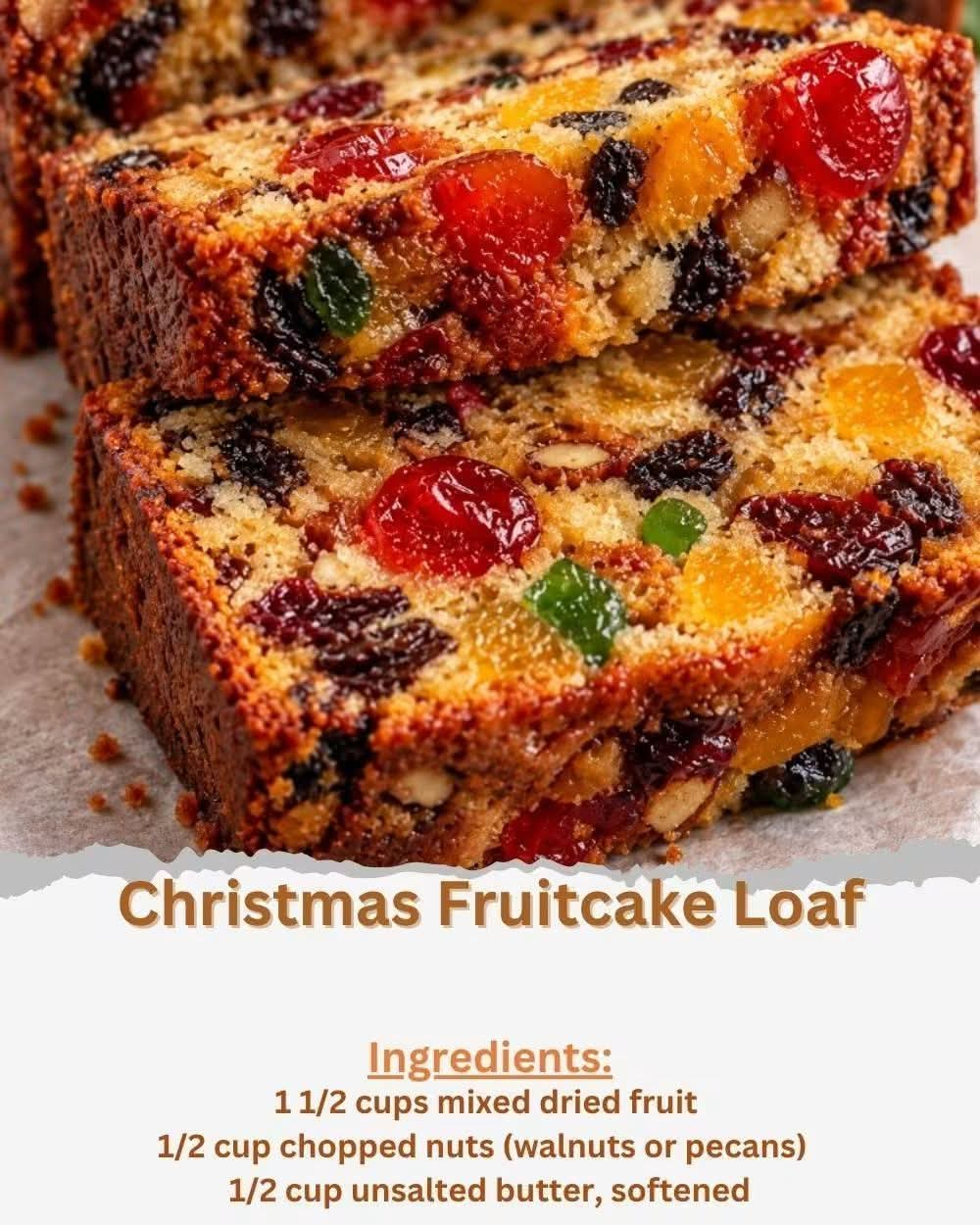
Christmas Fruitcake Loaf
Introduction
Christmas Fruitcake Loaf is a rich, fragrant, old-fashioned holiday bake filled with colorful dried fruit, candied peel, and crunchy nuts. It has a tender buttery crumb, warm spices, and a deep brown-sugar sweetness that makes every slice feel festive and comforting.
This loaf is especially wonderful during the Christmas season because it can be prepared ahead of time and allowed to rest, giving the flavors time to develop. It is delicious served with coffee, tea, hot chocolate, or as part of a holiday dessert table.
The combination of raisins, currants, dates, candied peel, and nuts creates a wonderful contrast of textures. The fruit becomes soft and chewy while the nuts provide a pleasant crunch throughout the cake.
Ingredients
For the Fruitcake Loaf
- 1 1/2 cups mixed dried fruit, such as raisins, currants, chopped dates, and candied peel
- 1/2 cup chopped walnuts or pecans
- 1/2 cup unsalted butter, softened
- 1 cup packed brown sugar
- 3 large eggs, room temperature
- 1 teaspoon vanilla extract
- 1 1/2 cups all-purpose flour
- 1 teaspoon baking powder
- 1/2 teaspoon baking soda
- 1/2 teaspoon salt
- 1 teaspoon ground cinnamon
- 1/2 teaspoon ground nutmeg
- 1/4 teaspoon ground cloves
- 1/4 teaspoon ground ginger
- 1/2 cup milk
- 2 tablespoons orange juice
- 1 teaspoon finely grated orange zest
Optional Fruit Soaking Mixture
For an especially moist and flavorful loaf:
- 1/4 cup orange juice
- 2 tablespoons water
- 1 teaspoon vanilla extract
The dried fruit can be soaked briefly before mixing into the batter.
Instructions
Step 1: Prepare the Fruit
Place the mixed dried fruit in a small bowl. Pour the orange juice and water over the fruit and let it sit for approximately 20 to 30 minutes.
This step softens the dried fruit and helps keep it tender after baking. Drain any excess liquid before adding the fruit to the batter.
If you prefer not to soak the fruit, you can use it directly, although soaking produces a softer and more flavorful result.
Step 2: Prepare the Pan
Preheat the oven to 325°F (165°C).
Grease a 9 x 5-inch loaf pan with butter or cooking spray. Line the bottom and long sides with parchment paper, leaving a little paper hanging over the edges to make the finished loaf easier to remove.
Step 3: Combine the Dry Ingredients
In a medium bowl, whisk together the flour, baking powder, baking soda, salt, cinnamon, nutmeg, cloves, and ginger.
Mixing the spices evenly into the flour helps distribute their flavor throughout the loaf.
Set the dry ingredients aside.
Step 4: Cream the Butter and Sugar
Place the softened butter and brown sugar in a large mixing bowl.
Beat for several minutes until the mixture becomes lighter, creamy, and fluffy.
The brown sugar gives the loaf its characteristic caramel-like flavor and helps create a moist texture.
Step 5: Add the Eggs
Add the eggs one at a time, beating well after each addition.
Add the vanilla extract, orange zest, and orange juice. Mix until everything is evenly incorporated.
If the mixture looks slightly curdled at this stage, do not worry. Once the flour is incorporated, the batter will come together.
Step 6: Add the Dry Ingredients and Milk
Add approximately one-third of the dry ingredients to the butter mixture and mix gently.
Add half of the milk and continue mixing.
Repeat with another portion of the flour mixture, followed by the remaining milk, and finish with the remaining dry ingredients.
Do not overmix. Stop as soon as the batter is smooth and combined.
Step 7: Add the Fruit and Nuts
Fold the soaked and drained dried fruit into the batter using a spatula.
Add the chopped walnuts or pecans and gently fold them through.
Make sure the fruit and nuts are distributed evenly without overworking the batter.
Step 8: Fill the Loaf Pan
Transfer the batter to the prepared loaf pan.
Smooth the top with a spatula.
For a traditional appearance, you can arrange a few additional pieces of dried fruit and nuts over the top before baking.
Step 9: Bake
Place the loaf in the preheated oven and bake for approximately 60 to 75 minutes.
Because fruitcake is dense, baking time can vary. Begin checking around the 60-minute mark.
Insert a toothpick or wooden skewer into the center. It should come out clean or with only a few moist crumbs attached.
If the top becomes dark before the center has finished baking, loosely cover the loaf with aluminum foil and continue baking.
Step 10: Cool
Remove the loaf from the oven and allow it to cool in the pan for about 15 to 20 minutes.
Use the parchment paper to carefully lift the loaf from the pan and transfer it to a wire rack.
Allow it to cool completely before slicing.
For the best texture, let the loaf rest for several hours before serving.
Method
The method for this fruitcake loaf is based on the classic creaming technique.
First, the butter and brown sugar are beaten together to create a smooth and airy base. The eggs are then incorporated gradually, followed by the flavorings.
The dry ingredients are mixed separately so that the baking powder, baking soda, salt, and spices are evenly distributed.
The flour mixture is incorporated gently with the milk, preventing the batter from becoming overly dense. Finally, the dried fruit and nuts are folded in by hand.
Baking at a moderate temperature is important because fruitcake contains a large amount of fruit and sugar. A lower oven temperature allows the center to cook properly without causing the outside to become too dark.
History
Fruitcake has a long history in European baking traditions, where preserved fruits, nuts, spices, and sweetened cakes were commonly associated with celebrations and special occasions.
Before modern refrigeration, drying and preserving fruit was an important way of keeping seasonal produce available throughout the year. Dried fruits could then be incorporated into breads and cakes during the winter months.
Over time, fruit-filled cakes became strongly associated with Christmas and other winter celebrations. Different countries and families developed their own versions, using local fruits, nuts, spices, and baking traditions.
The Christmas fruitcake loaf is a simpler variation of these traditional fruitcakes. Instead of making a very large, heavily aged cake, the ingredients are baked in a loaf pan, creating a practical dessert that can easily be sliced and shared.
Formation of the Fruitcake Loaf
The character of this loaf comes from the way several ingredients work together.
The butter provides richness and tenderness, while brown sugar contributes sweetness, moisture, and a subtle caramel flavor. Eggs help bind the ingredients and give the loaf structure.
The flour forms the foundation of the cake, while baking powder and baking soda provide the necessary lift. Milk keeps the batter soft, while orange juice and zest brighten the rich flavors.
The dried fruit provides natural sweetness and a chewy texture. Candied peel contributes a concentrated citrus flavor, while walnuts or pecans add richness and crunch.
Finally, cinnamon, nutmeg, cloves, and ginger create the warm spice profile traditionally associated with Christmas baking.
Tips for a Moist Fruitcake Loaf
Use softened butter rather than melted butter when following the creaming method.
Bring the eggs and milk close to room temperature before mixing. This helps the batter combine more smoothly.
Do not overmix once the flour has been added. Excessive mixing can make the loaf heavier.
Soaking the dried fruit before baking is one of the easiest ways to improve the final texture.
Bake slowly and check the loaf toward the end of the recommended baking time.
Allow the loaf to cool completely before slicing. Cutting it while very warm can cause the crumb to crumble.
For an even deeper flavor, wrap the completely cooled loaf tightly and let it rest overnight before serving.
Serving Suggestions
Christmas Fruitcake Loaf can be served plain, allowing the fruit, nuts, and spices to shine.
For a more festive presentation, dust the cooled loaf lightly with powdered sugar.
It can also be served with:
- Whipped cream
- Vanilla ice cream
- A light vanilla glaze
- Orange glaze
- Cream cheese spread
- Warm custard
- A cup of coffee or tea
- Hot chocolate
Thin slices are ideal for afternoon tea, while thicker slices make a satisfying holiday dessert.
How to Store
Once completely cooled, wrap the loaf tightly in plastic wrap or place it in an airtight container.
It can be kept at room temperature for several days in a cool, dry place.
For longer storage, refrigerate the wrapped loaf. Allow it to come closer to room temperature before serving so the texture becomes softer and the flavors become more pronounced.
The loaf can also be frozen. Wrap it securely and freeze for up to several months. Thaw it overnight in the refrigerator or at room temperature before serving.
For Fruitcake Lovers
Fruitcake lovers will appreciate this loaf because it has the traditional flavors of Christmas fruitcake without requiring complicated preparation.
The dried fruit gives every slice something sweet and chewy, while the nuts provide a satisfying contrast. The brown sugar, orange, cinnamon, nutmeg, cloves, and ginger create a warm flavor that feels especially appropriate during the holiday season.
For those who enjoy a fruitier cake, additional raisins, currants, dates, or candied cherries can be added. If you prefer a nuttier loaf, the amount of walnuts or pecans can be increased slightly.
Conclusion
Christmas Fruitcake Loaf is a comforting holiday recipe that brings together buttery cake, brown sugar, dried fruit, nuts, citrus, and traditional Christmas spices.
It is simple enough for everyday home baking while still being special enough for Christmas gatherings, family celebrations, holiday breakfasts, and dessert tables.
The best part is that this loaf can be prepared ahead of time, allowing its flavors to settle and deepen. Served in generous slices with a warm drink, it becomes the kind of traditional holiday treat that invites everyone to slow down, gather around the table, and enjoy a taste of Christmas.