
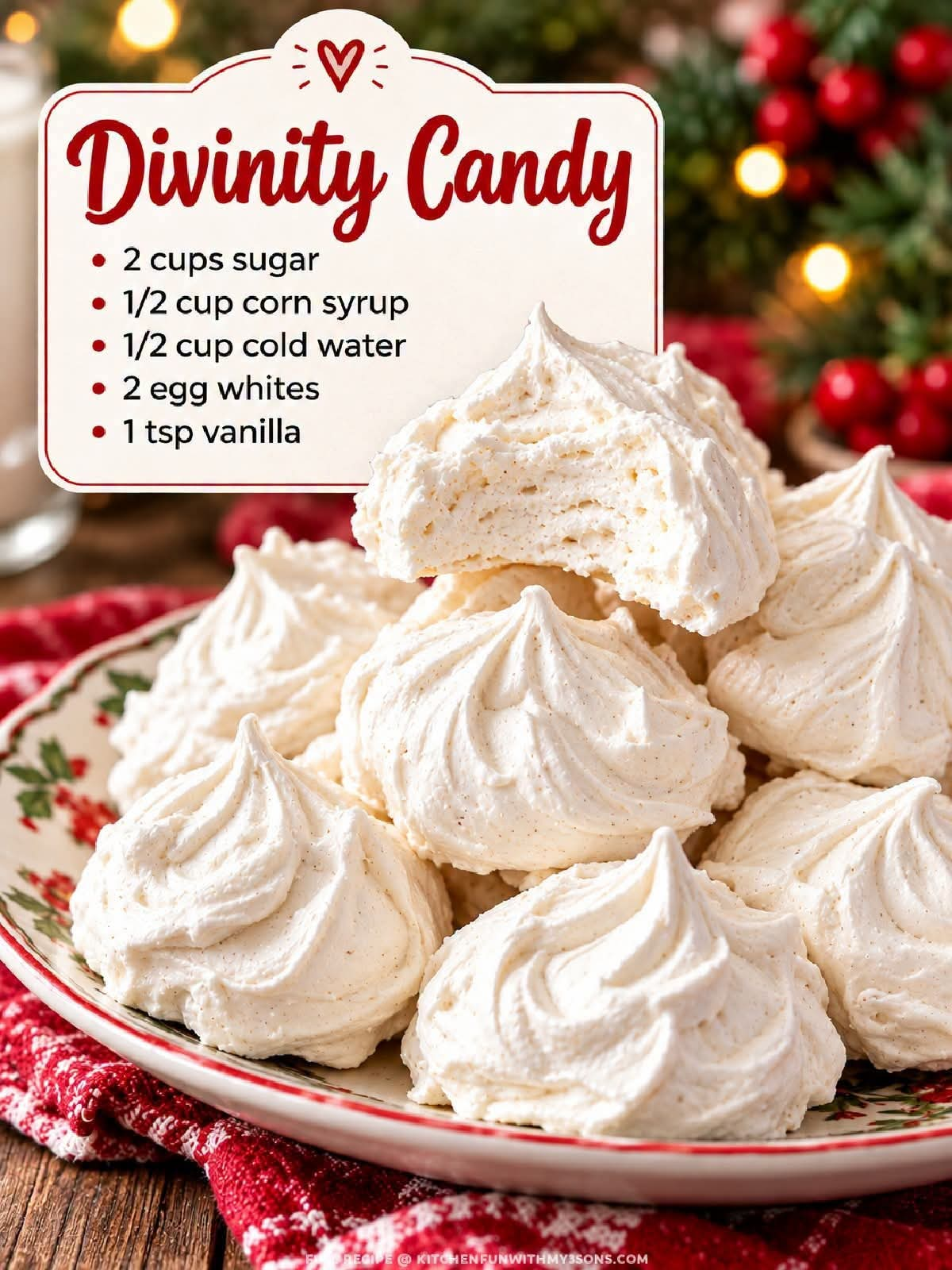
Old-Fashioned Divinity Candy – Melt-in-Your-Mouth Homemade Holiday Candy
Introduction
There is something truly special about old-fashioned Divinity Candy. With its delicate white appearance, soft and fluffy texture, and sweet vanilla flavor, this traditional homemade candy has been a favorite on holiday dessert tables for generations. Every bite melts in your mouth, leaving behind a light, creamy sweetness that makes it almost impossible to stop at just one piece.
Divinity is the kind of candy that brings back wonderful memories of Christmas celebrations, family gatherings, and afternoons spent in the kitchen with parents and grandparents. It looks elegant enough to give as a homemade gift, yet it is made with simple pantry ingredients that many home bakers already have on hand.
In our family, Divinity Candy is one of those holiday traditions that everyone looks forward to each year. We make a batch for Christmas, arrange the fluffy pieces on a beautiful serving tray, and share them with family, friends, and neighbors. Sometimes we add chopped pecans for a little crunch, while other times we keep the candy plain and let its delicate vanilla flavor shine.
Although Divinity Candy requires a little patience and careful attention to temperature, the results are worth the effort. Once you master the technique, you will have a timeless homemade treat that looks beautiful, tastes wonderful, and makes every holiday celebration feel more special.
Ingredients
Preparation time: 20 minutes
Cooking time: 15–20 minutes
Mixing and shaping time: 10–15 minutes
Total time: Approximately 45–55 minutes, plus setting time
Yield: About 30–40 pieces, depending on size
For the Divinity Candy
- 2 ½ cups granulated sugar
- ½ cup light corn syrup
- ½ cup water
- 2 large egg whites, at room temperature
- 1 teaspoon pure vanilla extract
- 1 cup chopped pecans or walnuts, optional
- A small pinch of salt, optional
Equipment Needed
- A heavy-bottomed saucepan
- A candy thermometer
- An electric stand mixer or hand mixer
- A heatproof mixing bowl
- A silicone spatula
- Two spoons
- Baking sheets lined with parchment paper or wax paper
Instructions
Step 1: Prepare Your Workspace
Before beginning, line two baking sheets with parchment paper or wax paper. Make sure your mixing bowl and beaters are clean and completely free from grease, because even a small amount of fat can prevent egg whites from whipping properly.
Measure all your ingredients in advance. Divinity Candy requires careful timing, especially when the hot sugar syrup reaches the correct temperature.
Choose a dry day if possible. Humidity can interfere with the candy’s ability to set properly, leaving it sticky or soft instead of light and fluffy.
Step 2: Cook the Sugar Syrup
In a heavy-bottomed saucepan, combine the granulated sugar, light corn syrup, and water.
Place the saucepan over medium heat and stir gently until the sugar dissolves. Once the mixture begins boiling, stop stirring to reduce the risk of sugar crystals forming along the sides of the pan.
Attach a candy thermometer to the saucepan, making sure its tip does not touch the bottom.
Continue cooking until the syrup reaches 260°F (127°C), the hard-ball stage. This temperature is important for achieving the traditional texture of Divinity Candy.
Watch the thermometer closely as the syrup approaches the target temperature. Avoid leaving the pan unattended.
Step 3: Beat the Egg Whites
While the syrup cooks, place the room-temperature egg whites and optional pinch of salt in a clean mixing bowl.
Beat the egg whites with an electric mixer until stiff peaks form. The whites should look glossy and hold their shape when you lift the beaters.
If the egg whites reach stiff peaks before the syrup is ready, reduce the mixer speed to low and wait briefly, taking care not to overbeat them.
Step 4: Add the Hot Syrup Slowly
Once the syrup reaches 260°F, remove the saucepan from the heat.
With the mixer running at medium speed, slowly pour the hot syrup into the beaten egg whites in a thin, steady stream. Aim for the side of the bowl rather than directly onto the beaters.
This step must be done carefully because the syrup is extremely hot. Pour slowly and avoid splashing.
Continue beating as the syrup is incorporated. The mixture will become thicker, brighter, and more voluminous as air is incorporated into the candy.
Step 5: Beat Until Thick and Fluffy
Continue beating the mixture until it becomes thick, glossy, and fluffy. This may take approximately 5–10 minutes, depending on your mixer and the temperature of the mixture.
Add the vanilla extract near the end of the mixing process.
To check the consistency, lift a spoonful of the mixture and let it fall back into the bowl. It should hold its shape briefly rather than immediately spreading into a thin puddle.
The mixture should be thick enough to scoop into small mounds while still being soft enough to work with. Avoid beating so long that it becomes dry, crumbly, or difficult to shape.
Step 6: Add the Nuts
If you enjoy a little crunch in your candy, gently fold in the chopped pecans or walnuts.
Pecans are especially popular in traditional Southern-style Divinity Candy because their rich, buttery flavor complements the sweetness beautifully.
For a plain version, simply skip the nuts. The candy will still have its signature soft texture and delicate vanilla taste.
Step 7: Shape the Candy
Working quickly, use two spoons to drop small portions of the mixture onto the prepared baking sheets.
Use one spoon to scoop the candy and the other to push it into a small mound. You can create soft peaks on top for a traditional homemade appearance.
If the mixture begins to stiffen before you finish shaping it, work with smaller portions and move efficiently. Divinity Candy becomes harder to shape as it cools.
Leave a little space between each piece so that the candies do not touch.
Step 8: Let the Candy Set
Allow the candy to rest at room temperature for several hours, or until the pieces are dry to the touch and hold their shape.
Depending on the humidity and the consistency of the mixture, setting may take longer. Avoid refrigerating the candy immediately, as moisture can make its surface sticky.
Once fully set, carefully remove the pieces from the parchment paper.
Step 9: Serve and Enjoy
Arrange the finished candies on a festive serving platter, in small paper candy cups, or in a decorative holiday tin.
The finished Divinity Candy should be light, airy, sweet, and delicate, with a soft interior that melts in your mouth.
Serve it alongside Christmas cookies, fudge, peanut butter balls, chocolate truffles, or other homemade holiday treats.
Methods for Making Perfect Divinity Candy
The Traditional Stovetop Method
The stovetop method is the classic way to prepare Divinity Candy. Cooking the sugar syrup to the correct temperature creates the structure needed for the candy to hold its shape.
Use a candy thermometer whenever possible. Guessing the temperature can lead to candy that remains sticky, becomes too hard, or fails to set.
The Electric Mixer Method
An electric mixer is strongly recommended because Divinity Candy needs sustained beating to develop its characteristic airy texture.
A stand mixer is especially convenient because it allows you to pour the syrup slowly while the mixer continues running. A hand mixer also works, but the process requires more attention and steady handling.
The Pecan Divinity Method
For a traditional nutty version, fold in one cup of finely chopped pecans after the mixture has thickened.
Avoid adding the nuts too early, because the mixture needs enough time to develop its fluffy structure before heavier ingredients are incorporated.
The Vanilla Divinity Method
For a simple, classic candy, omit the nuts and use pure vanilla extract. This version is especially good for people who prefer a smooth, delicate candy without crunchy pieces.
You can also experiment with a small amount of almond extract, but use it sparingly because its flavor is stronger than vanilla.
The History of Divinity Candy
Divinity Candy is an old-fashioned American confection that became especially popular in the early twentieth century. Its exact origin is uncertain, but it developed as part of the tradition of homemade sugar candies prepared for family gatherings, church celebrations, and holidays.
The name is often associated with the candy’s almost heavenly sweetness and light, cloudlike texture. Some accounts connect the name to the expression “divine,” although the precise origin of the name is not definitively established.
Traditional recipes use sugar, egg whites, and flavoring to create a delicate candy that is different from ordinary fudge or caramel. Corn syrup is frequently included to help control crystallization, while nuts such as pecans add flavor and texture.
For many American families, particularly in the Southern United States, Divinity Candy became a treasured Christmas tradition. It was often prepared alongside peanut brittle, fudge, pralines, and other homemade sweets.
The candy was especially appealing for holiday gifting because it could be made in batches, arranged in decorative tins, and shared with relatives and neighbors.
Today, Divinity Candy remains a beloved example of traditional home confectionery. Although modern desserts are often quicker to prepare, many people still enjoy making this delicate candy because it connects them with the flavors and traditions of earlier generations.
Formation and Texture: What Makes Divinity Candy Special?
The beauty of Divinity Candy comes from the combination of whipped egg whites and carefully cooked sugar syrup.
When egg whites are beaten, air becomes trapped in the protein structure, creating a light foam. The hot sugar syrup stabilizes that foam and gives the candy its sweetness and structure.
As the mixture cools, it becomes thicker and more stable. This allows the candy to be shaped into small mounds that hold their form while retaining a delicate, airy interior.
The final texture depends on several factors:
Correct syrup temperature: Reaching 260°F is essential for creating the proper structure.
Properly beaten egg whites: The egg whites need to reach stiff peaks before the syrup is added.
Slow syrup incorporation: Pouring the syrup gradually helps it blend evenly into the whipped egg whites.
Appropriate beating time: Beating long enough creates structure, but excessive beating can make the mixture dry and difficult to shape.
Low humidity: Moisture in the air can prevent the candy from drying properly.
When all these elements come together, the result is a sweet, cloudlike confection that is crisp enough on the outside to hold its shape and tender inside.
Common Mistakes and How to Avoid Them
Why Is My Divinity Candy Sticky?
Sticky candy often results from high humidity or sugar syrup that did not reach the correct temperature.
Use a candy thermometer, choose a relatively dry day, and allow the candy sufficient time to set at room temperature.
Why Did My Candy Not Set?
The syrup may have been undercooked, or the mixture may not have been beaten enough to develop the necessary structure.
Check the thermometer’s accuracy and make sure the mixture becomes thick enough to hold its shape before scooping.
Why Is My Candy Dry or Crumbly?
The mixture may have been beaten for too long after it reached the correct consistency.
Stop beating once it becomes thick and holds soft peaks. Begin shaping immediately.
Why Is My Candy Grainy?
Sugar crystals can form when the syrup is stirred after boiling begins or when crystals remain on the sides of the pan.
Stir only until the sugar dissolves, avoid scraping crystallized sugar from the pan’s sides into the syrup, and use a clean saucepan.
Why Did My Egg Whites Fail to Whip?
Grease, traces of egg yolk, or moisture in the mixing bowl can prevent egg whites from reaching stiff peaks.
Use a clean, dry bowl and carefully separate the eggs before whipping.
Tips for the Best Homemade Divinity Candy
- Use a reliable candy thermometer for the most consistent results.
- Prepare the parchment-lined trays before cooking the syrup.
- Make sure the egg whites are at room temperature.
- Keep water away from the finished candy once it begins to set.
- Use chopped pecans for a classic Southern flavor.
- Work quickly after the mixture reaches the correct consistency.
- Avoid making Divinity Candy on very humid or rainy days when possible.
- Store the finished candy in an airtight container in a cool, dry place.
- Separate layers with parchment paper to prevent the pieces from sticking together.
- For the best texture, allow the candy to set completely before storing it.
Storage and Gift-Giving Ideas
Once the candies are fully set, place them in an airtight container with parchment paper between the layers. Keep the container in a cool, dry location away from direct sunlight and moisture.
For the best texture, enjoy the candy within about one week. Storage life can vary depending on humidity and handling, so check for changes in texture or appearance before serving.
Divinity Candy is also a lovely homemade holiday gift. Arrange the pieces in a festive tin, a small food-safe gift box, or individual candy cups. Add a simple ribbon and a handwritten recipe card for a thoughtful personal touch.
If you are preparing the candy for friends or family, remember to mention that it contains egg whites and may contain nuts if pecans or walnuts are included.
Because this recipe uses egg whites without a separate final cooking step that guarantees pasteurization, use pasteurized egg whites suitable for whipping if food safety is a concern. Follow the product instructions, as some pasteurized egg whites do not whip as well as ordinary egg whites.
Serving Suggestions
Divinity Candy fits beautifully into a holiday dessert spread.
Serve it with:
- Homemade chocolate fudge
- Peanut butter balls
- Pecan pralines
- Christmas sugar cookies
- Chocolate-covered pretzels
- Caramel candies
- Hot chocolate or coffee
- A platter of assorted homemade Christmas sweets
Its light texture provides a pleasant contrast to richer desserts, making it an excellent addition to a holiday candy tray.
For a beautiful presentation, arrange the white candy in small paper cups and alternate it with darker chocolate treats or golden caramel candies.
Conclusion
Old-Fashioned Divinity Candy is more than just a sweet treat. It is a reminder of family traditions, holiday celebrations, and the simple pleasure of sharing homemade food with the people we love.
With its delicate texture, sweet vanilla flavor, and optional pecan crunch, this classic candy deserves a place on the Christmas table. Although making it requires patience and attention to temperature, the reward is a beautiful homemade confection that looks elegant and tastes wonderfully nostalgic.
Prepare a batch for your next holiday gathering, wrap a few pieces for friends, or make it part of your own annual Christmas tradition. Once you experience the soft, melt-in-your-mouth texture of homemade Divinity Candy, you may find yourself returning to this timeless recipe every year.
For Divinity Candy Lovers
If you love old-fashioned homemade candy, this recipe is a wonderful place to begin. It is sweet, airy, and beautiful enough for special occasions while still carrying the comforting feeling of a family recipe passed down through generations.
The best part is watching simple ingredients transform into something so delicate and delicious. Whether you prefer classic vanilla Divinity or the traditional pecan-filled version, each piece brings a little sweetness to the holiday season.
Make it for Christmas, share it with your neighbors, or serve it after a family dinner. Homemade Divinity Candy is the kind of old-fashioned treat that makes people smile and ask for another piece.
A little holiday tradition, a handful of simple ingredients, and a whole lot of homemade sweetness—that is the magic of Divinity Candy.