
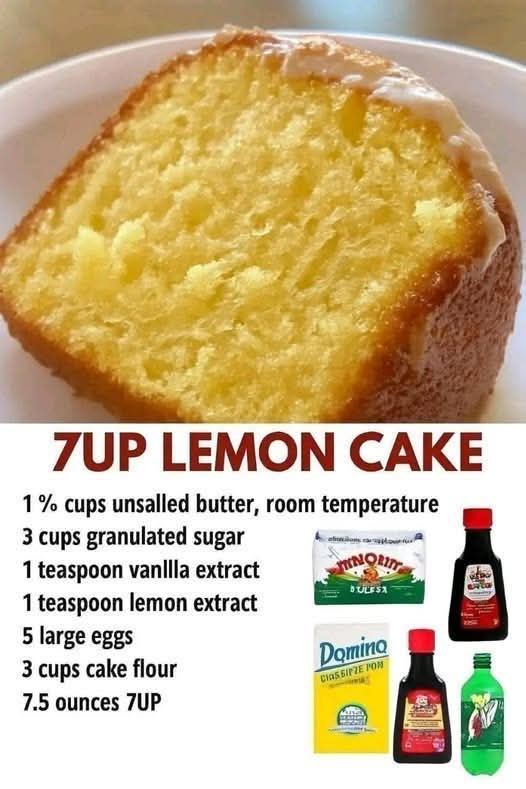
7UP Lemon Cake
Introduction
7UP Lemon Cake is a classic, old-fashioned Bundt cake known for its rich buttery texture, delicate lemon flavor, and wonderfully tender crumb. Made with simple pantry ingredients and lemon-lime soda, this cake is both comforting and impressive.
The combination of butter, sugar, eggs, flour, fresh lemon, and 7UP creates a substantial pound-cake-style dessert that remains moist without becoming heavy or soggy. A fresh lemon glaze adds a bright finishing touch and balances the richness of the cake.
This cake is perfect for family gatherings, holidays, birthdays, potlucks, afternoon tea, Sunday dinners, or simply enjoying a slice with a cup of coffee.
Ingredients
For the Cake
- 3 cups all-purpose flour
- 3 cups granulated sugar
- 1½ cups unsalted butter, softened
- 5 large eggs, at room temperature
- 7.5 ounces 7UP, approximately 1 cup
- 2 tablespoons fresh lemon juice
- 1 tablespoon finely grated lemon zest
- 1 teaspoon vanilla extract
- ½ teaspoon salt
For the Lemon Glaze
- 1½ cups powdered sugar
- 2 to 3 tablespoons fresh lemon juice
- 1 tablespoon 7UP
- 1 teaspoon finely grated lemon zest
- ½ teaspoon vanilla extract, optional
Equipment
- 10-inch Bundt pan
- Large mixing bowl
- Electric mixer
- Medium bowl
- Measuring cups and spoons
- Rubber spatula
- Wire cooling rack
- Small bowl for the glaze
- Fine grater or zester
Instructions
Method 1: Prepare the Bundt Pan
Begin by preparing the Bundt pan carefully.
Generously grease a 10-inch Bundt pan with softened butter or baking spray. Make sure the butter or spray reaches the grooves, sides, center tube, and bottom of the pan.
Lightly dust the greased pan with flour. Turn the pan over and gently tap out any excess flour.
This step is particularly important because Bundt pans have detailed surfaces where cakes can easily stick.
Preheat the oven to 325°F (165°C).
Method 2: Prepare the Ingredients
Bring the butter and eggs to room temperature before beginning.
The butter should be softened but not melted. Room-temperature butter creams much more effectively with the sugar.
Crack the eggs into a small bowl if desired so they can easily be added one at a time.
Wash and dry the lemon. Finely grate the yellow outer skin to make the lemon zest. Avoid grating into the white pith because it can have a bitter taste.
Juice the lemon and measure 2 tablespoons for the cake.
Measure the flour carefully. For the most consistent result, spoon the flour into measuring cups and level the top with a knife rather than packing the flour into the cup.
Method 3: Cream the Butter and Sugar
Place the softened butter in a large mixing bowl.
Beat the butter on medium speed until it becomes smooth and creamy.
Gradually add the granulated sugar while continuing to beat.
Cream the butter and sugar together for approximately 4 to 6 minutes.
The mixture should become lighter in color, fluffy, and noticeably increased in volume.
Do not rush this stage. Proper creaming helps create the cake’s fine, tender texture.
Method 4: Add the Eggs
Add the eggs one at a time.
Beat well after each addition before adding the next egg.
Scrape down the sides and bottom of the bowl occasionally with a rubber spatula to ensure that everything is evenly incorporated.
Once all five eggs have been added, mix in the vanilla extract, fresh lemon juice, and finely grated lemon zest.
Mix only until combined.
At this stage, the batter should be rich, smooth, and fragrant with lemon.
Method 5: Combine the Dry Ingredients
In a separate bowl, whisk together the all-purpose flour and salt.
Whisking the dry ingredients helps distribute the salt evenly throughout the flour.
Do not overwork the flour.
Method 6: Alternate the Flour and 7UP
Add approximately one-third of the flour mixture to the butter mixture.
Mix on low speed just until incorporated.
Add approximately half of the 7UP and mix gently.
Continue alternating between the flour mixture and 7UP.
Begin with flour and finish with flour.
A simple sequence is:
- Flour
- 7UP
- Flour
- Remaining 7UP
- Final flour
Mix only until each addition is incorporated.
Do not overmix the batter because excessive mixing can develop the gluten in the flour and make the cake less tender.
Method 7: Finish the Batter
Once the final flour has been incorporated, stop mixing as soon as no dry streaks remain.
The batter should be thick, smooth, creamy, and rich.
The lemon zest should be evenly distributed throughout the batter.
The 7UP contributes liquid and lemon-lime flavor to the mixture.
Avoid vigorous stirring after adding the soda.
Method 8: Fill the Bundt Pan
Carefully spoon the batter into the prepared Bundt pan.
Use a rubber spatula to distribute the batter evenly around the pan.
Smooth the surface gently.
Tap the pan lightly on the counter once or twice to help release any unusually large air pockets.
Do not repeatedly bang the pan, as this is unnecessary.
Method 9: Bake the Cake
Place the Bundt pan on the center rack of the preheated oven.
Bake at 325°F (165°C) for approximately 70 to 85 minutes.
Begin checking the cake around the 70-minute mark because oven temperatures and Bundt pans can vary.
The cake is ready when the top is golden brown and the cake has begun pulling slightly away from the sides of the pan.
Insert a wooden skewer or cake tester into the thickest portion of the cake.
It should come out clean or with a few moist crumbs attached.
The center should feel firm and should spring back lightly when gently touched.
If the top is becoming too brown before the center has finished baking, loosely cover the cake with aluminum foil for the remaining baking time.
Method 10: Cool the Cake
Remove the finished cake from the oven.
Place the Bundt pan on a wire cooling rack and allow the cake to cool in the pan for approximately 15 to 20 minutes.
Do not immediately attempt to remove the cake while it is extremely hot.
After the initial cooling period, carefully loosen any areas around the edges or center tube that appear stuck.
Place a cooling rack over the Bundt pan.
Carefully invert the pan so the cake releases onto the rack.
Allow the cake to cool completely before applying the glaze.
Cooling the cake properly helps maintain its structure and reduces the chance of cracking or breaking.
Lemon Glaze Method
Place the powdered sugar in a small bowl.
Add 2 tablespoons of fresh lemon juice and 1 tablespoon of 7UP.
Whisk until smooth.
Add the remaining lemon juice a few drops at a time until the glaze reaches the desired consistency.
If the glaze becomes too thin, add a little more powdered sugar.
Stir in the finely grated lemon zest.
Add the vanilla extract if desired.
The finished glaze should be smooth and thick enough to coat the cake while still flowing slowly down the sides.
Once the cake is completely cool, drizzle the glaze over the top.
Allow the glaze to set for several minutes before slicing.
Formation of the Cake
The character of this cake comes from the way each ingredient contributes to the final structure.
The butter provides richness, flavor, and tenderness.
The sugar provides sweetness while also contributing to the cake’s delicate crumb.
The eggs provide structure, richness, and moisture. They also help the cake rise and hold its shape.
The flour creates the framework of the cake.
The 7UP contributes liquid and a mild lemon-lime flavor. Although carbonation is present in the soda, it should not be considered the cake’s primary leavening system. The cake’s structure depends primarily on the eggs, creaming process, and the overall formulation.
Fresh lemon zest provides concentrated citrus aroma, while lemon juice adds acidity and brightness.
The result is a dense but tender cake with a moist crumb, buttery flavor, and refreshing citrus finish.
History of 7UP Cake
7UP cakes are part of a broader American tradition of incorporating familiar commercial ingredients into homemade baking.
Lemon-lime soda became a popular addition to cakes because its flavor naturally complements ingredients such as butter, sugar, eggs, vanilla, and lemon.
Soda cakes became particularly recognizable in American home baking during the twentieth century as home cooks experimented with convenient packaged foods and beverages.
The 7UP cake became especially associated with Southern-style baking and is often prepared as a Bundt or pound-style cake.
Its popularity has endured because it combines a relatively simple ingredient list with an impressive finished appearance.
A beautifully glazed Bundt cake can look elegant enough for a celebration while still retaining the comforting character of an old-fashioned homemade dessert.
Serving Suggestions
Allow the glaze to set before slicing the cake.
Serve generous slices at room temperature.
This cake pairs beautifully with:
- Coffee
- Black tea
- Green tea
- Fresh strawberries
- Fresh blueberries
- Fresh raspberries
- Whipped cream
- Vanilla ice cream
- Lemon curd
- Lightly sweetened cream
For a beautiful presentation, drizzle the glaze generously over the ridges of the Bundt cake and finish with a small amount of fresh lemon zest.
For afternoon tea, serve thin slices alongside fresh berries and hot tea.
For dessert, serve a warm or room-temperature slice with a scoop of vanilla ice cream.
Tips for the Best 7UP Lemon Cake
Use Softened Butter
The butter should be soft enough to beat easily but should not be melted.
Melted butter will not cream properly with the sugar and can change the texture of the cake.
Use Room-Temperature Eggs
Room-temperature eggs incorporate more easily into the butter mixture and help produce a smoother batter.
Cream the Butter and Sugar Thoroughly
Spend the full 4 to 6 minutes properly creaming the butter and sugar.
This step is one of the most important factors in creating a fine crumb.
Measure Flour Carefully
Too much flour can make the cake heavy or dry.
For consistent results, spoon flour into a measuring cup and level it rather than scooping directly from the container.
Do Not Overmix
Once the flour has been incorporated, stop mixing.
Overmixing can make the cake tougher.
Use Fresh Lemon
Fresh lemon zest and juice provide a much brighter citrus flavor than bottled lemon juice.
Prepare the Bundt Pan Carefully
Pay special attention to the grooves and center tube.
A thoroughly greased and lightly floured pan makes releasing the cake much easier.
Do Not Remove the Cake Too Quickly
Allow the cake to rest in the Bundt pan for 15 to 20 minutes after baking.
This gives the cake time to firm up before being inverted.
Glaze a Completely Cooled Cake
A cool cake gives you a more attractive glaze.
If the cake is still warm, the glaze can become too thin and run off the surface.
Variations
Extra-Lemon 7UP Cake
For a stronger lemon flavor, increase the lemon zest slightly and prepare a more lemon-forward glaze.
You can also add a small amount of additional lemon zest over the finished glaze.
Lemon-Lime 7UP Cake
Add a small amount of finely grated lime zest along with the lemon zest.
This creates a brighter lemon-lime character that complements the 7UP.
Powdered Sugar Finish
For a simpler presentation, skip the glaze.
Once the cake has cooled completely, dust the top lightly with powdered sugar.
Berry-Topped 7UP Cake
Serve slices with fresh strawberries, raspberries, or blueberries.
Add a spoonful of lightly sweetened whipped cream for an elegant dessert.
Creamy Lemon Dessert
Serve each slice with a small spoonful of lemon curd and whipped cream.
The additional lemon flavor pairs beautifully with the buttery cake.
Lovers of This Cake
This recipe is especially appealing to people who enjoy traditional pound cakes, buttery Bundt cakes, citrus desserts, and classic homemade baking.
It is also an excellent make-ahead dessert.
The cake can be prepared a day in advance, allowing the flavors to develop while the crumb remains tender.
For a gathering, bake the cake the day before, allow it to cool completely, cover it tightly, and add the glaze shortly before serving.
Storage
Store the completely cooled and glazed cake in an airtight container at room temperature for up to 3 days.
For longer storage, refrigerate the cake in a tightly covered container for approximately 5 to 7 days.
Allow refrigerated slices to sit at room temperature for a short time before serving so the texture becomes softer and more enjoyable.
Freezing
The cake can also be frozen without the glaze.
Wrap the completely cooled cake tightly in plastic wrap, followed by aluminum foil.
Freeze for up to 2 to 3 months.
When ready to serve, thaw the cake completely.
Prepare the lemon glaze fresh and drizzle it over the thawed cake.
Complete Method at a Glance
- Grease and flour a 10-inch Bundt pan.
- Preheat the oven to 325°F (165°C).
- Bring the butter and eggs to room temperature.
- Cream the softened butter and sugar for 4 to 6 minutes.
- Add the eggs one at a time.
- Add vanilla, lemon juice, and lemon zest.
- Whisk together the flour and salt.
- Alternately add the flour mixture and 7UP.
- Mix only until the batter is combined.
- Transfer the batter to the prepared Bundt pan.
- Bake for approximately 70 to 85 minutes.
- Test the center with a wooden skewer.
- Cool in the pan for 15 to 20 minutes.
- Carefully invert the cake onto a cooling rack.
- Cool completely.
- Prepare the lemon glaze.
- Drizzle the glaze over the cooled cake.
- Allow the glaze to set.
- Slice and serve.
Conclusion
7UP Lemon Cake is a wonderful example of how familiar ingredients can come together to create a memorable homemade dessert.
The buttery pound-cake-style base provides richness and substance, while fresh lemon zest and juice bring brightness. The 7UP contributes liquid and a subtle lemon-lime character, helping create the cake’s distinctive texture and flavor.
The final lemon glaze completes the dessert with a sweet, tangy finish.
Whether served at a family gathering, holiday celebration, birthday, potluck, afternoon tea, or simply alongside a cup of coffee, this cake offers the comforting taste of traditional homemade baking.
Prepare it carefully, allow it to cool completely, add the fresh lemon glaze, and slice it generously. The result is a beautiful, tender, buttery lemon cake that is simple enough for everyday baking and special enough for any celebration.