
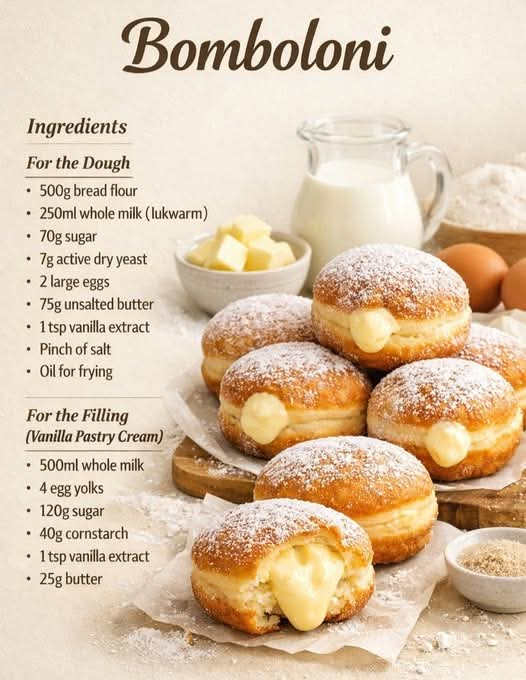
Bomboloni Recipe: Italian Filled Doughnuts
Introduction
Bomboloni are soft, pillowy Italian doughnuts that are traditionally fried until golden, filled generously with pastry cream, and finished with a coating of sugar. They are especially associated with Tuscany, where they are commonly enjoyed for breakfast, as an afternoon treat, or as a sweet accompaniment to coffee.
What makes a good bombolone special is the contrast between the lightly crisp exterior and the exceptionally soft, airy interior. Once filled with silky vanilla pastry cream, every bite becomes rich, creamy, and indulgent.
This recipe makes approximately 12–14 bomboloni, depending on the size you choose.
Ingredients
For the Bomboloni Dough
- 500 g bread flour
- 250 ml whole milk, lukewarm
- 70 g granulated sugar
- 7 g active dry yeast
- 2 large eggs, room temperature
- 75 g unsalted butter, softened
- 1 teaspoon vanilla extract
- 1 generous pinch of salt
- Vegetable or sunflower oil, for deep frying
For the Vanilla Pastry Cream
- 500 ml whole milk
- 4 large egg yolks
- 120 g granulated sugar
- 40 g cornstarch
- 1 teaspoon vanilla extract
- 25 g unsalted butter
For Finishing
- Granulated sugar, approximately 150–200 g
- Optional: a little extra vanilla sugar for coating
Equipment
- Large mixing bowl or stand mixer
- Whisk
- Wooden spoon or dough scraper
- Rolling pin
- Round cookie or dough cutter, approximately 7–8 cm
- Baking trays
- Parchment paper
- Deep, heavy saucepan or deep fryer
- Kitchen thermometer
- Slotted spoon
- Piping bag fitted with a long filling nozzle
Method
Step 1: Activate the Yeast
Pour the lukewarm milk into a small bowl. It should feel warm but not hot.
Add the yeast and approximately 1 teaspoon of the sugar. Stir gently and leave for 5–10 minutes.
The mixture should become slightly foamy. This indicates that the yeast is active.
If using instant yeast instead of active dry yeast, it can generally be mixed directly into the flour without proofing.
Step 2: Make the Dough
Place the bread flour, remaining sugar, and salt into a large mixing bowl.
Add the eggs, vanilla extract, and the milk-and-yeast mixture.
Mix until a rough, sticky dough begins to form.
If using a stand mixer, use the dough hook and knead on low to medium speed for approximately 5–7 minutes.
If kneading by hand, transfer the dough to a lightly floured work surface and knead for approximately 10 minutes.
The dough should gradually become smoother and more elastic.
Step 3: Add the Butter
Add the softened butter gradually, one small piece at a time.
Continue kneading until each addition is incorporated before adding the next.
This is important because the butter makes the dough rich and tender, but adding it too quickly can make the dough difficult to develop.
Continue kneading until the dough is smooth, elastic, soft, and slightly tacky.
A properly developed dough should stretch without immediately tearing.
Step 4: First Rise
Shape the dough into a ball and place it into a lightly greased bowl.
Cover with plastic wrap or a clean kitchen towel.
Leave in a warm, draft-free place for approximately 1½–2 hours, or until the dough has roughly doubled in size.
The exact rising time will depend on the temperature of your kitchen.
Step 5: Prepare the Pastry Cream
While the dough is rising, prepare the vanilla pastry cream.
Pour the milk into a saucepan and heat it over medium heat until steaming. Do not allow it to boil vigorously.
In a separate bowl, whisk together the egg yolks, sugar, and cornstarch until smooth and pale.
Gradually pour some of the hot milk into the egg mixture while whisking constantly.
This gently raises the temperature of the eggs and prevents them from scrambling.
Pour the mixture back into the saucepan.
Cook over medium-low heat, whisking continuously, until the pastry cream becomes thick and smooth.
Once thickened, remove from the heat and stir in the vanilla and butter.
Transfer the pastry cream to a clean bowl.
Press plastic wrap directly against the surface of the cream to prevent a skin from forming.
Allow it to cool, then refrigerate until completely chilled.
Before using, whisk the chilled pastry cream briefly until smooth and creamy.
Step 6: Shape the Bomboloni
Once the dough has doubled in size, gently press it down to remove excess air.
Transfer it to a lightly floured work surface.
Roll the dough to approximately 1–1.5 cm thick.
Using a 7–8 cm round cutter, cut out circles.
Place each dough circle onto a small square of parchment paper or onto a parchment-lined baking tray, leaving enough room between them for expansion.
Gather the scraps, gently knead them together, allow them to rest for several minutes, and cut additional bomboloni.
Avoid adding excessive flour because this can make the finished doughnuts heavy.
Step 7: Second Rise
Cover the shaped dough lightly with a clean towel or plastic wrap.
Allow the bomboloni to rise for approximately 30–60 minutes.
They should become noticeably puffy and light.
Do not allow them to overproof, because excessively fermented dough can collapse during frying.
Step 8: Heat the Oil
Pour enough vegetable or sunflower oil into a deep, heavy saucepan to allow the bomboloni to float freely.
Heat the oil to approximately 170–175°C.
A kitchen thermometer is strongly recommended.
If the oil is too hot, the outside will brown before the center is cooked.
If it is too cool, the doughnuts can absorb excessive oil and become greasy.
Step 9: Fry the Bomboloni
Carefully place a few bomboloni into the hot oil.
Do not overcrowd the pan because this can cause the oil temperature to drop.
Fry for approximately 2–3 minutes per side, turning gently with a slotted spoon.
They should become evenly golden brown and puffed.
Remove them from the oil and place them on a tray lined with paper towels or a wire rack.
Continue until all the bomboloni are fried.
Step 10: Coat With Sugar
While the bomboloni are still warm, roll each one generously in granulated sugar.
The warm surface helps the sugar adhere beautifully.
For an especially fragrant finish, mix the sugar with a small amount of vanilla sugar.
Step 11: Fill the Bomboloni
Transfer the chilled vanilla pastry cream into a piping bag fitted with a long, narrow nozzle.
Make a small opening in the side of each bombolone.
Insert the piping tip and squeeze gently until the center feels generously filled.
Do not overfill them, as too much pastry cream can cause the doughnut to split.
Arrange the finished bomboloni on a serving platter.
Important Methods and Techniques
Developing the Dough
The dough should be kneaded until it becomes elastic and smooth. Proper gluten development gives bomboloni their characteristic soft, airy structure.
Adding Butter Gradually
Butter should be incorporated after the initial dough has developed. Adding it gradually helps the dough retain structure and prevents it from becoming excessively greasy or difficult to knead.
Controlling the Oil Temperature
Maintaining approximately 170–175°C is one of the most important steps. Use a thermometer whenever possible.
Frying in Small Batches
Too many doughnuts in the pan will reduce the oil temperature. Frying several at a time produces more consistent color and texture.
Filling After Frying
The pastry cream should be cold and thick enough to hold its shape. The bomboloni should be completely or mostly cooled before filling so the cream does not become excessively warm.
The History of Bomboloni
Bomboloni are part of Italy’s long tradition of fried pastries. The name is associated with the Italian word “bomba,” meaning “bomb,” reflecting their round, plump appearance.
They are particularly connected with Tuscany, where bomboloni became a beloved bakery and café treat. Italian regional doughnuts vary considerably, and bomboloni developed their own identity as soft, enriched fried doughnuts commonly filled with pastry cream, chocolate, or other sweet fillings.
Today, bomboloni can be found throughout Italy and have become increasingly popular internationally. Modern versions may contain pistachio cream, chocolate-hazelnut spread, lemon cream, ricotta, fruit preserves, or other fillings.
Formation and Texture
The formation of the bomboloni depends on several stages working together.
The yeast creates fermentation and produces carbon dioxide, which expands inside the dough. The eggs and butter enrich the dough, giving it a tender texture, while bread flour provides enough gluten structure to hold the gases created during fermentation.
During frying, the water in the dough turns into steam. This causes the dough to expand further, creating the light and fluffy interior associated with a well-made bombolone.
The result should be:
- Golden and lightly crisp outside
- Soft and airy inside
- Rich but not heavy
- Slightly sweet
- Generously filled
- Fresh and fragrant
Tips for Perfect Bomboloni
- Do not use very hot milk for the yeast. Excessive heat can damage the yeast.
- Use room-temperature eggs. They incorporate more easily into the enriched dough.
- Use softened butter. Cold butter is difficult to incorporate evenly.
- Do not add too much flour. A slightly tacky dough generally produces softer bomboloni.
- Watch the second rise carefully. The dough should look puffy but still have enough strength to withstand frying.
- Maintain the frying temperature. Approximately 170–175°C is ideal.
- Fry in small batches. This helps maintain consistent temperature.
- Do not fill them while extremely hot. Allow them to cool enough that the pastry cream remains thick and creamy.
- Fill generously but carefully. The goal is to have pastry cream in the center without splitting the dough.
- Serve fresh. Bomboloni are at their best on the day they are made.
Variations
Chocolate Bomboloni
Replace the vanilla pastry cream with a rich chocolate pastry cream.
Pistachio Bomboloni
Fill with pistachio pastry cream and finish with finely chopped pistachios.
Lemon Bomboloni
Add finely grated lemon zest to the pastry cream and replace part of the vanilla flavor with fresh lemon juice.
Strawberry Bomboloni
Fill with pastry cream and add a small amount of strawberry preserve to the center.
Hazelnut Bomboloni
Fill with chocolate-hazelnut spread or combine it with pastry cream for a lighter, creamier filling.
Storage
Bomboloni are best eaten fresh.
Unfilled fried bomboloni can be kept in an airtight container for approximately 1 day, although their texture is best shortly after frying.
Because the filling contains dairy and eggs, filled bomboloni should be refrigerated if they are not being eaten promptly. Allow refrigerated bomboloni to sit briefly at room temperature before serving for the best texture.
For the best results, prepare the pastry cream in advance and fry and fill the bomboloni on the day you plan to serve them.
Serving Suggestions
Bomboloni are wonderful served with:
- Espresso
- Cappuccino
- Latte
- Hot chocolate
- Fresh berries
- Seasonal fruit
- A dusting of powdered sugar
- Additional pastry cream on the side
They make an excellent breakfast pastry, afternoon coffee treat, brunch dessert, or impressive homemade dessert.
Conclusion
Homemade bomboloni are a beautiful example of Italian pastry making: simple ingredients transformed through fermentation, careful kneading, gentle shaping, controlled frying, and generous filling.
The finished doughnut should be golden on the outside, soft and airy inside, coated in sugar, and filled with smooth vanilla pastry cream. Although the recipe requires several stages, each stage contributes to the final texture and flavor.
For lovers of Italian pastries, bomboloni are especially rewarding because they combine the comfort of a doughnut with the elegance of homemade pastry cream. Once you master the basic dough, you can create countless variations using chocolate, pistachio, lemon, fruit, coffee, or hazelnut fillings.
The best bomboloni are meant to be shared while fresh, preferably alongside a good cup of coffee and enjoyed slowly, one delicious bite at a time.