
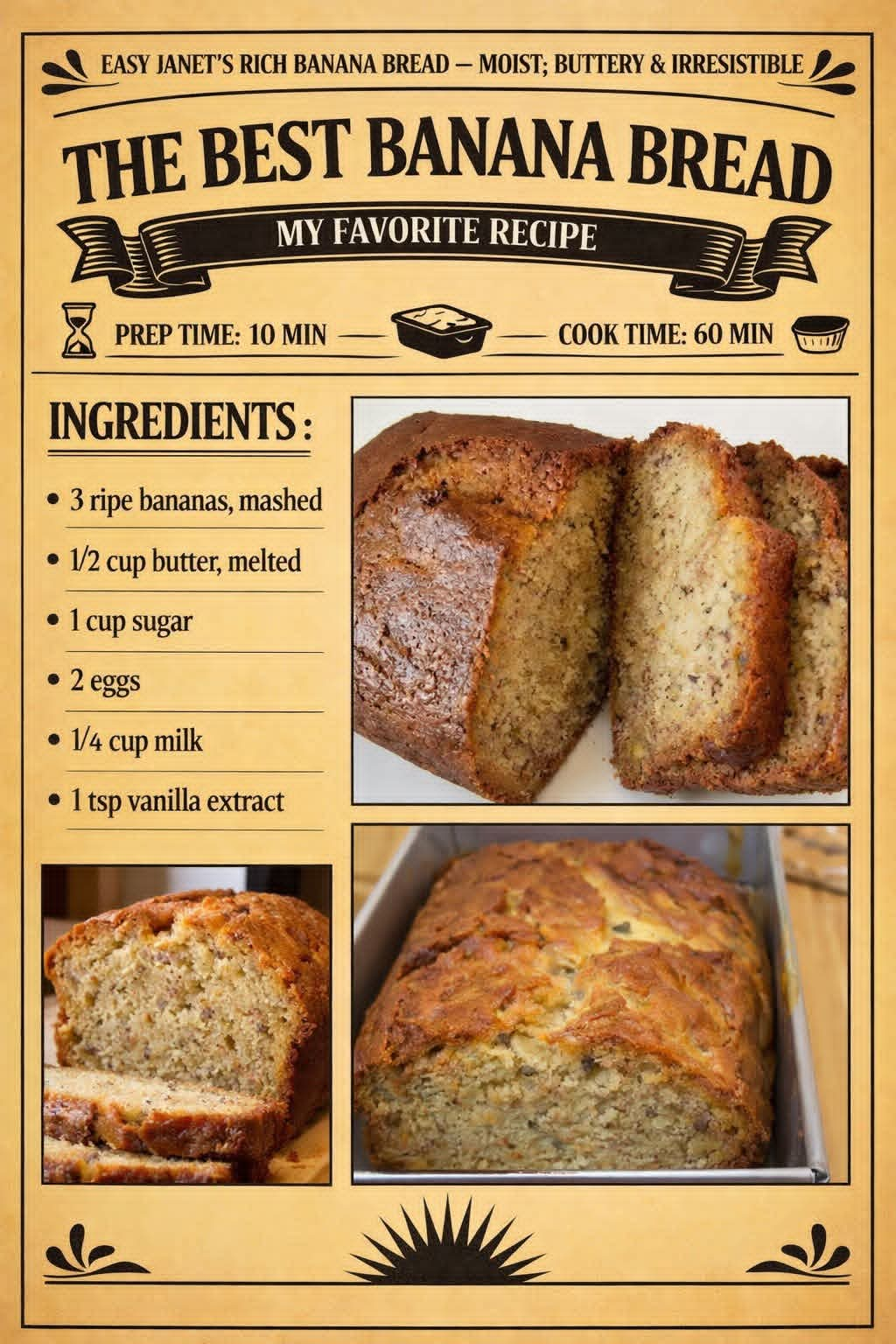
Janet’s Rich Banana Bread
Introduction
Janet’s Rich Banana Bread is the kind of old-fashioned homemade treat that makes the kitchen smell wonderful and brings everyone to the table. It is moist, buttery, tender, and filled with the naturally sweet flavor of ripe bananas. The recipe uses simple ingredients that are easy to keep on hand, making it an excellent choice whenever you have a few overripe bananas waiting on the counter.
The combination of mashed bananas, melted butter, sugar, eggs, milk, and vanilla creates a rich loaf with a soft interior and a beautifully golden crust. It is delicious warm from the oven, but it becomes even more flavorful after cooling and resting.
This banana bread is versatile enough for breakfast with coffee, an afternoon snack with tea, or a comforting dessert after dinner. It can also be sliced and packed for lunch or enjoyed as a simple homemade gift.
Ingredients
For the Banana Bread
- 3 very ripe bananas, mashed
- 1/2 cup unsalted butter, melted
- 1 cup granulated sugar
- 2 large eggs
- 1/4 cup milk
- 1 teaspoon vanilla extract
- 1 1/2 cups all-purpose flour
- 1 teaspoon baking soda
- 1/2 teaspoon salt
Optional Additions
For extra flavor or texture, you can add:
- 1/2 teaspoon ground cinnamon
- 1/2 cup chopped walnuts or pecans
- 1/2 cup chocolate chips
- 1/2 teaspoon nutmeg
- A small handful of sliced banana for the top
Instructions
Step 1: Prepare the Oven and Pan
Preheat your oven to 350°F (175°C).
Grease a standard 9 x 5-inch loaf pan with butter or nonstick cooking spray. You can also line the pan with parchment paper, leaving some paper hanging over the sides. This makes removing the finished banana bread much easier.
Step 2: Mash the Bananas
Place the ripe bananas in a large mixing bowl and mash them thoroughly with a fork.
A few small pieces of banana are perfectly fine. In fact, they can add little pockets of banana flavor throughout the loaf.
The riper the bananas, the better. Bananas with plenty of brown spots are naturally sweeter and softer, which makes them especially suitable for banana bread.
Step 3: Add the Wet Ingredients
Pour the melted butter into the mashed bananas and stir until combined.
Add the sugar, eggs, milk, and vanilla extract. Whisk or stir gently until the mixture becomes smooth and evenly combined.
Do not worry if the mixture looks slightly uneven. The banana pieces will blend into the batter as the bread bakes.
Step 4: Combine the Dry Ingredients
In a separate bowl, whisk together the flour, baking soda, and salt.
If you are using cinnamon or nutmeg, add them to the dry ingredients as well.
Mixing the dry ingredients separately helps distribute the baking soda and salt evenly throughout the flour.
Step 5: Make the Batter
Gradually add the dry ingredients to the banana mixture.
Stir gently with a wooden spoon or spatula just until the flour disappears.
Do not overmix the batter. A few small lumps are completely acceptable. Overmixing can develop too much gluten and make the finished banana bread dense or chewy instead of soft and tender.
If you are adding nuts or chocolate chips, fold them into the batter at this stage.
Step 6: Fill the Loaf Pan
Pour the finished batter into the prepared loaf pan.
Use a spatula to spread the batter evenly and smooth the top.
If desired, place a sliced banana lengthwise across the top before baking for an attractive homemade appearance.
Step 7: Bake
Place the loaf pan in the preheated oven and bake for approximately 50 to 65 minutes.
The exact baking time can vary depending on your oven, the size of your bananas, and the type of loaf pan used.
Begin checking the bread around the 50-minute mark. Insert a toothpick or thin skewer into the center. If it comes out clean or with a few moist crumbs attached, the banana bread is ready.
If the top is becoming too dark before the center is fully baked, loosely cover the loaf with aluminum foil and continue baking.
Step 8: Cool
Remove the banana bread from the oven and allow it to cool in the pan for approximately 10 to 15 minutes.
Carefully lift the loaf from the pan and transfer it to a wire rack.
Allow it to cool further before slicing. Although it can be tempting to cut into it immediately, allowing the loaf to rest helps the crumb finish setting and makes it easier to slice.
Methods
The One-Bowl Method
For a simple preparation, the wet ingredients can be mixed together in one large bowl before the dry ingredients are added.
This method keeps cleanup to a minimum and is ideal when you want homemade banana bread without spending a lot of time in the kitchen.
The Gentle Mixing Method
The most important technique is to mix the batter gently.
Once the flour is added, stir only until the ingredients are combined. This produces a softer loaf with a tender texture.
The Ripe Banana Method
Very ripe bananas are the secret to rich banana flavor. As bananas ripen, their texture softens and their natural sweetness becomes more pronounced.
If you have bananas that are too ripe to enjoy on their own, they are often perfect for banana bread.
The Moisture-Control Method
Bananas vary greatly in size and moisture. If your bananas are exceptionally large and wet, the batter may be softer than expected.
If necessary, add a tablespoon or two of flour to achieve a thick but spoonable batter. Avoid adding too much flour because that can make the bread dry.
History of Banana Bread
Banana bread became especially popular in American home baking during the twentieth century. The recipe was an economical way to use bananas that had become too ripe to eat fresh.
The rise of commercial baking ingredients such as baking soda and baking powder also made quick breads easier for home cooks to prepare. Unlike traditional yeast breads, banana bread does not require kneading, rising, or a long fermentation period.
Banana bread eventually became a familiar part of American home cooking, appearing in family recipe collections, community cookbooks, newspapers, and household baking traditions.
Its popularity has continued because the basic recipe is inexpensive, adaptable, and forgiving. Different families developed their own versions by adding nuts, spices, chocolate chips, raisins, or other ingredients.
Formation and Texture
The formation of banana bread begins with the combination of moisture from the bananas, milk, eggs, and butter.
The eggs help provide structure, while the flour gives the loaf its framework. Baking soda creates air and helps the bread rise during baking.
As the loaf heats in the oven, the butter melts completely, the eggs set, the flour structure develops, and the sugars caramelize slightly around the crust. This produces the characteristic golden exterior and soft interior associated with classic banana bread.
The finished loaf should be moist without being wet, tender without falling apart, and firm enough to slice neatly.
Tips for Perfect Banana Bread
Use very ripe bananas whenever possible. Brown-spotted bananas usually provide better flavor and sweetness than firm yellow bananas.
Measure flour carefully. Too much flour is one of the most common reasons banana bread becomes dry.
Do not overmix after adding the flour.
Use room-temperature eggs when possible for easier mixing.
Do not slice the loaf immediately after removing it from the oven. Give it time to cool and set.
If your oven tends to brown baked goods quickly, check the loaf earlier and cover the top loosely with foil if necessary.
For clean slices, use a sharp serrated knife and allow the loaf to cool completely.
Serving Suggestions
Janet’s Rich Banana Bread can be served plain, warm, or at room temperature.
For breakfast, serve a thick slice with coffee, tea, or milk.
For an afternoon snack, spread a little softened butter over the top.
For dessert, warm a slice and serve it with whipped cream, vanilla ice cream, or a light drizzle of honey.
You can also toast slices in a skillet or toaster oven until the edges become lightly crisp while the center remains soft.
Storage
Allow the banana bread to cool completely before storing.
Wrap the loaf tightly in plastic wrap or place it in an airtight container. It can generally be kept at room temperature for several days.
For longer storage, slice the bread and freeze the individual slices in freezer-safe bags or containers. Place parchment paper between slices if desired so they can be removed individually.
Thaw slices at room temperature or gently warm them before serving.
Variations
Walnut Banana Bread
Fold 1/2 cup of chopped walnuts into the batter before baking. The walnuts add a pleasant crunch and pair beautifully with the sweet banana flavor.
Cinnamon Banana Bread
Add 1/2 teaspoon of cinnamon to the dry ingredients for a warmer, more aromatic loaf.
Chocolate Chip Banana Bread
Fold 1/2 cup of chocolate chips into the batter. For an especially rich version, sprinkle a few additional chips over the top before baking.
Pecan Banana Bread
Replace the walnuts with chopped pecans for a buttery, slightly sweet nutty flavor.
Banana Streusel Bread
Before baking, cover the batter with a simple mixture of flour, brown sugar, butter, and cinnamon. The topping creates a sweet, crumbly layer over the loaf.
Conclusion
Janet’s Rich Banana Bread is a comforting classic that proves you do not need complicated ingredients or complicated techniques to make something special.
With ripe bananas, buttery richness, a tender crumb, and a golden crust, this loaf is perfect for using up bananas while creating a homemade treat that the whole family can enjoy.
It is simple enough for an ordinary weekday but delicious enough to serve when guests arrive. Whether enjoyed warm with butter, packed for a snack, or served as dessert, this banana bread is the kind of recipe that can easily become a family favorite.
For Banana Bread Lovers
If you love traditional homemade baking, this recipe is especially easy to make your own. Add walnuts for crunch, cinnamon for warmth, chocolate chips for extra richness, or simply keep it classic with nothing more than ripe bananas and the buttery batter.
The best part is that every loaf can be slightly different depending on the bananas and additions you choose. That homemade quality is what makes banana bread so special.
A warm slice, a cup of coffee, and a quiet moment are sometimes all you need for a simple and satisfying treat.