
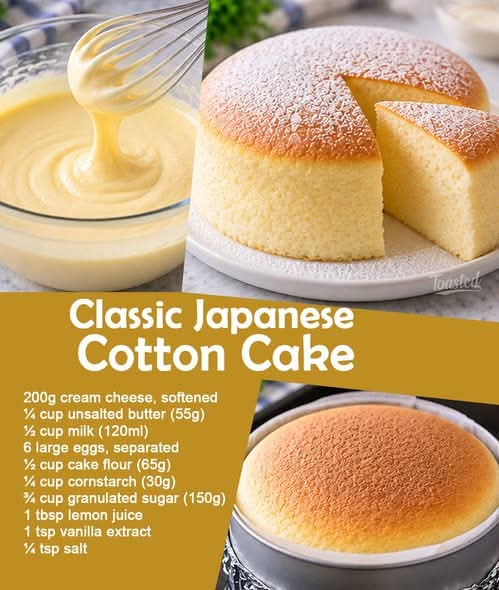
Classic Japanese Cotton Cake – Soft, Fluffy, and Delicate Cheesecake
Introduction
Classic Japanese Cotton Cake is one of the most delicate and beautiful cakes you can make at home. Known for its incredibly soft texture, gentle sweetness, and light, airy crumb, this cake combines the richness of cream cheese with the delicate structure of a perfectly whipped egg-white meringue.
Unlike traditional American cheesecake, which is dense and creamy, Japanese cotton cake is wonderfully light and fluffy. Each slice feels almost like a cloud, with a subtle cream cheese flavor, a hint of vanilla, and a refreshing touch of lemon.
The secret to its signature texture lies in three essential techniques: gently melting the cream cheese with butter and milk, carefully folding whipped egg whites into the batter, and baking the cake slowly in a hot-water bath.
Whether you serve it for a family gathering, afternoon tea, a birthday celebration, or a special weekend dessert, this Japanese cotton cake is sure to impress everyone at the table.
Ingredients
Preparation time: 25–30 minutes
Baking time: 60–75 minutes
Cooling time: 1–2 hours
Yield: 8–10 slices
For the cream cheese batter
- 200 g cream cheese, softened
- 55 g unsalted butter
- 120 ml milk
- 6 large eggs, separated into yolks and whites
- 65 g cake flour
- 30 g cornstarch
- 150 g granulated sugar
- 1 tablespoon lemon juice
- 1 teaspoon vanilla extract
- ¼ teaspoon salt
Optional toppings
- Powdered sugar for dusting
- Fresh strawberries or blueberries
- Lightly sweetened whipped cream
- Fresh fruit slices
- A little lemon zest for extra fragrance
Instructions
Step 1: Prepare the oven and cake pan
Preheat your oven to 150°C (300°F).
Prepare an 8-inch round cake pan by lining the bottom and sides with parchment paper. Allow the parchment on the sides to extend slightly above the rim to accommodate the cake as it rises.
Wrap the outside of the pan with aluminum foil to help prevent water from entering during the water-bath baking process. If your pan has a removable bottom, use several secure layers of foil.
Set the prepared pan aside.
Step 2: Melt the cream cheese mixture
Place the cream cheese, butter, and milk in a heatproof bowl.
Set the bowl over a saucepan of gently simmering water, making sure the bottom of the bowl does not touch the water. Stir slowly until the cream cheese and butter have melted and the mixture becomes smooth.
Alternatively, heat the ingredients very gently in a saucepan over low heat, stirring constantly.
Remove the mixture from the heat and allow it to cool slightly. It should be warm rather than hot before adding the egg yolks.
Step 3: Add the egg yolks and flavorings
Add the six egg yolks to the slightly cooled cream cheese mixture, one at a time, whisking thoroughly after each addition.
Stir in the vanilla extract and lemon juice.
Sift the cake flour, cornstarch, and salt into the mixture. Whisk gently until the batter becomes smooth and free of lumps.
For an especially delicate texture, strain the batter through a fine-mesh sieve. This helps remove any remaining lumps and creates a silky foundation for the cake.
Set the batter aside while you prepare the meringue.
Step 4: Whip the egg whites
Place the six egg whites in a clean, dry mixing bowl. Make sure the bowl and beaters are free from grease and that no egg yolk has contaminated the whites.
Beat the egg whites at medium speed until they become foamy.
Add the granulated sugar gradually, a little at a time, while continuing to beat.
Increase the speed slightly and whip until the meringue forms soft peaks. When you lift the whisk, the peaks should hold briefly before gently bending over.
Avoid whipping the egg whites until they become extremely stiff or dry. Overwhipped meringue is harder to fold into the batter and can cause the cake to develop an uneven texture or crack during baking.
Step 5: Fold the meringue into the batter
Add approximately one-third of the whipped egg whites to the cream cheese batter.
Whisk gently to loosen the batter and make it easier to combine.
Add the remaining meringue in two additions. Using a spatula, carefully fold from the bottom of the bowl upward, turning the bowl as you work.
Continue folding only until the mixture is evenly combined and no large white streaks remain.
The finished batter should look light, airy, and smooth. Avoid vigorous stirring because it will knock out the air that gives Japanese cotton cake its characteristic fluffiness.
Step 6: Fill the cake pan
Pour the batter slowly into the prepared cake pan.
Gently tap the pan against the counter once or twice to release any large trapped air bubbles. Do not tap it too forcefully, as the batter depends on the air incorporated into the meringue.
Smooth the surface with a spatula if necessary.
Place the cake pan inside a larger, deep baking tray.
Step 7: Prepare the water bath
Carefully pour hot water into the larger baking tray until it reaches approximately 2–3 cm up the sides of the cake pan.
The water bath helps the cake bake gently and evenly while maintaining moisture inside the oven. This is essential for achieving the delicate, custard-like texture of Japanese cotton cake.
Take care not to splash water into the batter.
Step 8: Bake the cake slowly
Place the tray on the middle rack of the preheated oven.
Bake at 150°C (300°F) for approximately 60–75 minutes.
Avoid opening the oven door during the first 45–50 minutes, because sudden temperature changes can cause the cake to collapse.
The cake is ready when the top is lightly golden, the center is set but still has a gentle wobble, and a skewer inserted into the center comes out without wet batter.
Ovens vary, so begin checking toward the end of the baking period. If the top browns too quickly before the center is set, reduce the temperature slightly.
Step 9: Cool the cake gradually
When the cake is baked, turn off the oven and leave the cake inside for about 15 minutes with the oven door slightly open.
This gradual cooling helps minimize sudden shrinkage and cracking.
Remove the cake from the water bath and carefully take off the foil. Let it cool until the pan is comfortable to handle.
Gently remove the cake from the pan and peel away the parchment paper.
Allow it to cool completely before slicing. For a firmer, more cheesecake-like texture, refrigerate it for 2–3 hours before serving.
Step 10: Decorate and serve
Place the cooled cake on a serving plate.
Dust the top lightly with powdered sugar, if desired. You can also serve it with fresh berries, a small spoonful of whipped cream, or a few thin slices of fresh fruit.
Use a sharp knife to cut clean slices, wiping the blade between cuts.
Serve at room temperature for a softer, airier texture or chilled for a more delicate cheesecake consistency.
Methods for Making the Perfect Japanese Cotton Cake
1. The cream cheese melting method
Melting the cream cheese with butter and milk creates a smooth, rich base. Gentle heat is important because overheating can cause the mixture to become oily or uneven.
If small lumps remain, whisk thoroughly or strain the mixture before adding the flour.
2. The soft-peak meringue method
The meringue is responsible for much of the cake’s height and softness.
Use clean equipment, add sugar gradually, and stop beating when the egg whites reach soft peaks. This creates a flexible foam that folds easily into the cream cheese batter.
3. The gentle folding method
Folding preserves the tiny air bubbles that expand during baking.
Use a spatula rather than an electric mixer at this stage. Move the spatula through the center of the bowl, scrape along the bottom, and lift the mixture over itself while rotating the bowl.
4. The water-bath baking method
The water bath creates a humid baking environment and reduces the intensity of direct heat.
It helps the cake cook evenly and lowers the risk of a dry exterior with an undercooked center.
5. The gradual cooling method
A sudden temperature drop can cause the cake to shrink dramatically.
Leaving it in the switched-off oven for 15 minutes gives the structure time to settle before it is exposed to cooler air.
The History of Japanese Cotton Cake
Japanese cotton cake, commonly known as Japanese soufflé cheesecake, is a modern Japanese dessert inspired by Western-style cheesecake and soufflé techniques.
Cream cheese became popular in Japanese baking as Western desserts gained a wider audience. Japanese bakers adapted traditional cheesecake recipes to create a lighter cake with a delicate texture that suited local preferences for balanced sweetness and soft baked goods.
The result was a dessert that combined the creamy flavor of cheesecake with the airy structure of a soufflé.
Over time, Japanese cotton cheesecake became popular in bakeries and cafés, attracting attention for its gentle wobble, golden top, and remarkably soft interior. Its popularity later spread internationally through bakery shops, food blogs, recipe videos, and social media.
Today, home bakers enjoy making it because the ingredients are familiar, yet the final result feels special and elegant.
Formation: What Makes This Cake So Light?
The beautiful texture of Japanese cotton cake comes from the interaction of its ingredients and baking method.
- Cream cheese provides the signature tangy flavor and creamy body.
- Butter adds richness and helps create a tender crumb.
- Milk loosens the batter and contributes moisture.
- Egg yolks give the cake color, richness, and structure.
- Cake flour and cornstarch provide a delicate framework without making the cake heavy.
- Whipped egg whites introduce air that expands in the oven, helping the cake rise.
- Sugar sweetens the cake and stabilizes the meringue.
- Lemon juice adds freshness and helps support the egg-white foam.
- Low-temperature baking and a water bath allow the cake to cook gently without drying out too quickly.
When these elements work together, the cake develops its signature combination of a soft, fluffy interior and a thin, lightly golden exterior.
Tips for Success
- Bring the cream cheese and eggs to room temperature before beginning.
- Measure the flour and cornstarch accurately.
- Separate the eggs carefully, keeping all yolk out of the whites.
- Use soft peaks rather than stiff peaks for the meringue.
- Fold slowly and gently to preserve the air in the batter.
- Make sure the water bath is prepared before putting the cake in the oven.
- Avoid opening the oven door too early.
- Allow the cake to cool gradually before removing it from the pan.
- Do not worry if the cake shrinks slightly as it cools; some shrinkage is normal.
Common Problems and How to Fix Them
Why did my cake collapse?
The meringue may have been underwhipped, overwhipped, or deflated during folding. The cake may also have been underbaked or cooled too quickly. Make sure the center is set before turning off the oven.
Why did the top crack?
The oven may have been too hot, or the meringue may have been too stiff. Try reducing the oven temperature slightly and checking that the cake is baking evenly.
Why is the cake dense?
Overmixing after adding the meringue or using flour measurements that are too high can make the cake heavy. Fold gently and measure the dry ingredients carefully.
Why is the center wet?
The cake may need additional baking time. Check that the center is set and that a skewer does not come out coated in raw batter. If needed, continue baking in short intervals.
Why did the cake shrink?
Some shrinkage is natural because the cake contains a large amount of whipped egg whites. Gradual cooling and thorough baking help minimize excessive shrinkage.
Serving Ideas and Variations

Classic powdered sugar cake
Keep it simple with a light dusting of powdered sugar. This allows the delicate cream cheese flavor and fluffy texture to shine.

Fresh berry cotton cake
Serve with strawberries, blueberries, or raspberries for a refreshing contrast to the creamy cake.

Lemon cotton cake
Add a little finely grated lemon zest to the batter for a brighter citrus aroma.

Cream-topped dessert
Add a small amount of lightly sweetened whipped cream for an elegant afternoon tea or celebration dessert.
Storage Instructions
- Refrigerator: Store the cake in an airtight container for up to 3 days.
- Serving: Allow refrigerated slices to stand at room temperature for approximately 10–15 minutes if you prefer a softer texture.
- Freezing: Individual slices can be wrapped securely and frozen for up to 1 month for best quality. Thaw overnight in the refrigerator.
Because this cake contains eggs and dairy, refrigerate it promptly after cooling rather than leaving it at room temperature for extended periods.
Conclusion
Classic Japanese Cotton Cake is a wonderful example of how simple ingredients can create something extraordinary. With cream cheese, eggs, milk, butter, and a little patience, you can prepare a dessert that is rich in flavor yet wonderfully light in texture.
The secret is not complicated equipment or expensive ingredients. It is the careful preparation of the cream cheese batter, the gentle handling of the meringue, the slow water-bath baking, and the gradual cooling that allows the cake to maintain its delicate structure.
Serve it plain with tea or coffee, decorate it with fresh berries, or enjoy a chilled slice straight from the refrigerator. However you choose to serve it, this soft Japanese cotton cake is a beautiful treat for everyday moments and special occasions alike.
For the Lovers of Japanese Cotton Cake
If you love light desserts, creamy cheesecake, and cakes that practically melt in your mouth, this recipe deserves a place in your collection.
It is perfect for people who enjoy desserts that are less heavy than traditional cheesecake but still offer a rich, satisfying flavor. Every slice brings together the gentle tang of cream cheese, the sweetness of vanilla, and the airy texture created by whipped egg whites.
Make it for your family, share it with friends, or prepare it for your next afternoon tea. Once you master the technique, you may find yourself returning to this recipe whenever you want a dessert that looks elegant and tastes wonderfully delicate.
The best part is the first slice: a golden exterior, a soft center, and a light texture that makes every bite feel special.
Enjoy your homemade Classic Japanese Cotton Cake, made with care, patience, and a little baking magic.