
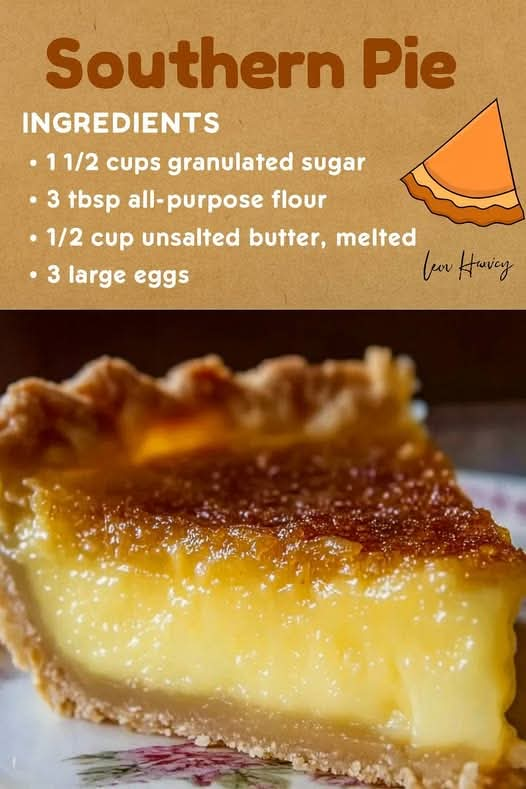
🥧 Classic Southern Buttermilk Pie
A true Southern staple, this pie is the definition of old-fashioned comfort baking. With its silky custard filling, lightly tangy buttermilk flavor, and buttery vanilla sweetness, Southern Buttermilk Pie has been passed down through generations of home bakers. It’s simple, humble, and unforgettable—one of those desserts that tastes like tradition in every bite.
🧾 Ingredients
- 1 ½ cups granulated sugar
- ½ cup unsalted butter, room temperature (1 stick)
- 3 large eggs
- 1 teaspoon vanilla extract
- ¼ teaspoon salt
- 3 tablespoons all-purpose flour
- 1 cup buttermilk
- 1 unbaked 9-inch pie shell
👩🍳 Method & Instructions
1. Prepare the oven
Preheat your oven to 350°F (175°C). Place the unbaked pie shell into a 9-inch pie dish and set aside.
2. Cream the base
In a large mixing bowl, beat together the butter and sugar until the mixture becomes light, smooth, and slightly fluffy. This step creates the rich, melt-in-your-mouth texture.
3. Add eggs and flavor
Mix in the eggs one at a time, beating well after each addition. Stir in the vanilla extract and salt.
4. Build the custard
Add the flour and mix until just combined. Slowly pour in the buttermilk, stirring until the filling becomes smooth and slightly thin—like a pourable custard.
5. Fill the crust
Pour the mixture into the unbaked pie shell, smoothing the top gently.
6. Bake
Bake for 45–55 minutes, or until the center is set and the top is golden with a slight jiggle in the middle.
7. Cool completely
Allow the pie to cool fully at room temperature so the custard sets properly. It will firm up more as it cools.
🔥 Methods (Baking Science Behind It)
This pie relies on a custard-setting method, where eggs act as the thickening agent. When heated, the proteins in the eggs gently coagulate, turning the liquid mixture into a soft, sliceable filling. The flour adds stability, while the buttermilk provides a slight tang that balances the sweetness and enhances tenderness.
Unlike cheesecake or cream pies, there’s no need for water baths or complicated techniques—just slow, even baking.
📜 History & Formation
Southern Buttermilk Pie originated in the American South, particularly in rural communities where ingredients were simple and accessible. Buttermilk was often a byproduct of homemade butter, and clever home cooks transformed it into desserts like chess pie and buttermilk pie.
It became especially popular during the Great Depression era, when resourceful baking turned pantry staples into comforting desserts. Over time, it evolved into a cherished Southern classic served at Sunday dinners, holidays, and family gatherings.
Its “formation” as a dessert reflects Southern baking culture: practical, economical, and deeply rooted in hospitality.
💛 Texture & Flavor Profile
- Creamy custard center
- Slight tang from buttermilk
- Sweet vanilla-butter balance
- Lightly caramelized top
- Soft yet set filling
Every bite melts smoothly with a gentle richness that never feels heavy.
💕 “Lovers of the Pie” Experience
People who love Southern Buttermilk Pie usually describe it as:
- “A taste of home in every slice”
- “Simple but addictive”
- “The pie that disappears first at gatherings”
It’s the kind of dessert that doesn’t need decoration or frosting—its charm is in its simplicity.
🍽️ Serving Suggestions (Lovers Methods)
For the best experience:
- Serve slightly chilled or room temperature
- Add a dusting of powdered sugar
- Pair with whipped cream or fresh berries
- Enjoy with coffee, tea, or milk
Some Southern bakers even add a pinch of nutmeg or lemon zest for a personal twist.
🧁 Conclusion
Southern Buttermilk Pie is more than just a dessert—it’s a tradition baked into a crust. It carries history, comfort, and simplicity all at once. With basic ingredients and a gentle baking method, it transforms into something timeless and deeply satisfying.
If you’re looking for a pie that feels like nostalgia in every bite, this one delivers exactly that.