
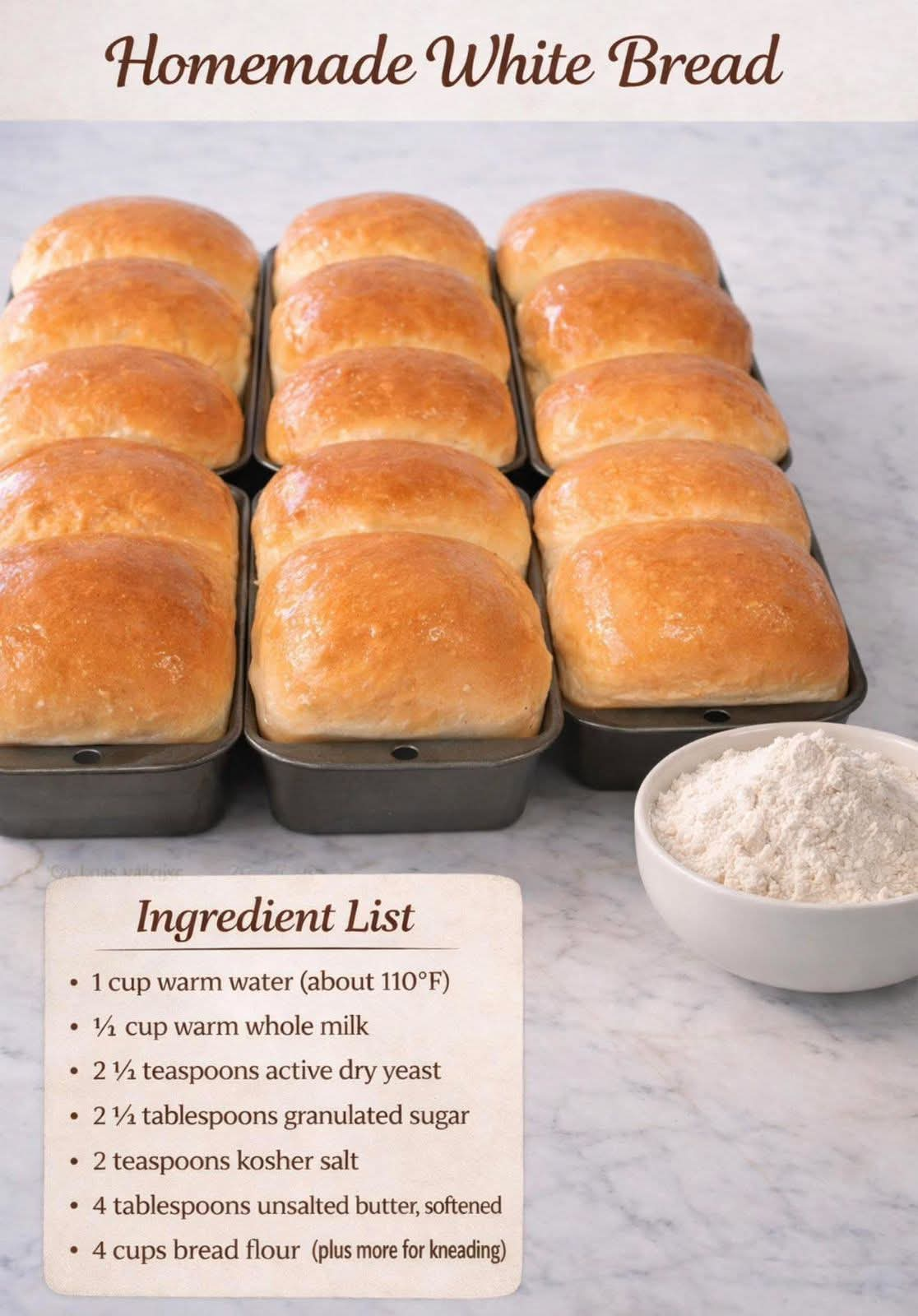
Here’s a full, expanded version of your Homemade White Bread recipe with a complete cooking guide and storytelling style.
🍞 Homemade White Bread (Soft & Fluffy Classic Loaf)
✨ Introduction
Homemade white bread is one of the most comforting staples in baking history. Soft, warm, and lightly sweet, it has been made for centuries in kitchens around the world. The smell of fresh bread rising and baking is often associated with home, family, and tradition. Unlike store-bought bread, homemade white bread has a richer flavor and a tender texture that comes from simple ingredients and patient rising.
This recipe gives you a soft loaf with a golden crust and fluffy interior—perfect for toast, sandwiches, or simply enjoying warm with butter.
🧂 Ingredients
(Note: Your ingredient list includes “6 cups warm water,” which seems likely to be a mistake. Standard bread recipes use only a small amount of water for dough, so this version corrects it for proper dough consistency.)
- 1 1/2 cups warm water (for yeast activation + dough)
- 1 1/2 teaspoons sugar (to activate yeast)
- 1 packet active dry yeast (2 1/4 tsp)
- 1/4 cup sugar (for dough sweetness)
- 1 1/2 teaspoons salt
- 2–3 tablespoons butter or oil (optional, for softness)
- 4 to 5 cups all-purpose flour (added gradually)
👩🍳 Instructions
1. Activate the Yeast
In a bowl, combine warm water (1 1/2 cups), 1 1/2 tsp sugar, and yeast. Stir gently and let it sit for 5–10 minutes until foamy.
This step proves the yeast is alive and ready to make your bread rise.
2. Make the Dough
Add the remaining sugar, salt, and butter/oil to the yeast mixture.
Gradually add flour, one cup at a time, mixing until a soft dough forms.
3. Knead the Dough
Transfer dough to a floured surface. Knead for 8–10 minutes until smooth and elastic.
Kneading develops gluten, which gives the bread structure and chew.
4. First Rise
Place dough in a greased bowl. Cover with a clean towel and let it rise for 1–1.5 hours, or until doubled in size.
5. Shape the Loaf
Punch down the dough gently to release air. Shape into a loaf and place into a greased bread pan.
6. Second Rise
Cover again and let rise for 30–45 minutes until puffy and slightly above the pan.
7. Bake
Bake in a preheated oven at 180°C (350°F) for 25–30 minutes, or until golden brown and hollow-sounding when tapped.
8. Cool
Remove from pan and cool on a wire rack before slicing.
🔬 Methods Explained
- Yeast activation: wakes up microorganisms that produce gas
- Gluten formation: kneading builds structure and elasticity
- Fermentation: rising process develops flavor and softness
- Baking: sets structure and creates golden crust through caramelization
📜 History of White Bread
White bread became popular in Europe after milling technology allowed fine white flour production. In earlier centuries, white bread was considered a luxury for wealthy families, while darker breads were more common among the general population. Over time, it became a global staple due to its soft texture and neutral flavor.
Today, it remains one of the most widely baked breads in homes worldwide.
🧁 Formation (How It Comes Together)
The transformation of simple ingredients into bread is a natural chemical process:
- Yeast eats sugar → produces carbon dioxide
- Gas gets trapped in dough → dough rises
- Heat expands gases → bread becomes airy and light
- Starch and proteins set → structure becomes firm
This is why bread feels alive during preparation—it literally is a living fermentation process.
💛 Serving & “Lovers” Ideas
Ways to enjoy it:
- Warm with butter and honey
- Toasted with jam or peanut butter
- Used for sandwiches
- Dipped in soups or stews
Bread lovers’ tips:
- Add garlic butter after baking for flavor
- Brush crust with melted butter for softness
- Sprinkle sesame or oats on top before baking
- Slice thick for French toast
🌟 Conclusion
Homemade white bread is more than a recipe—it’s a craft of patience and simplicity. With just flour, water, yeast, and time, you create something warm, nourishing, and deeply satisfying. Every loaf tells the story of transformation—from simple dough to a comforting staple shared at the table.
If you want, I can also turn this into a , a , or a .