
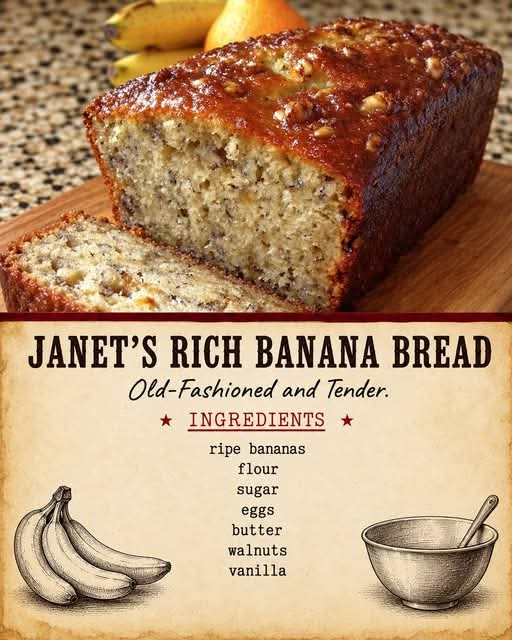
Janet’s Rich Banana Bread
Introduction
Janet’s Rich Banana Bread is the kind of old-fashioned homemade loaf that turns a few very ripe bananas into something wonderfully comforting. Rich, moist, tender, and filled with the warm flavor of ripe bananas, butter, vanilla, and walnuts, this banana bread is simple enough for an ordinary breakfast but delicious enough to serve for dessert.
The secret to its rich texture is using bananas that are very ripe and naturally sweet. As bananas ripen, their flavor becomes deeper and their flesh becomes softer, making them ideal for baking. Melted or softened butter adds richness, while walnuts provide a pleasant crunch throughout the tender loaf.
This recipe is especially useful when you have bananas sitting on the kitchen counter that are too soft for eating. Instead of throwing them away, transform them into a fragrant loaf that fills the kitchen with the comforting aroma of homemade baking.
Ingredients
For the Banana Bread
- 3 large very ripe bananas, mashed
- 2 cups all-purpose flour
- 3/4 cup granulated sugar
- 2 large eggs, room temperature
- 1/2 cup unsalted butter, melted and slightly cooled
- 1 teaspoon pure vanilla extract
- 1 teaspoon baking soda
- 1/2 teaspoon baking powder
- 1/2 teaspoon salt
- 3/4 cup chopped walnuts
Optional Additions
- 1/2 teaspoon ground cinnamon
- 1/4 teaspoon ground nutmeg
- 1/2 cup chocolate chips
- 1/2 cup additional chopped walnuts for the top
- 1 tablespoon brown sugar for sprinkling over the loaf
Instructions
Step 1: Prepare the Oven and Pan
Preheat the oven to 350°F (175°C).
Grease a 9-by-5-inch loaf pan with butter or nonstick cooking spray. You can also line the bottom and two long sides with parchment paper, leaving a little overhang to make the finished loaf easier to remove.
Set the prepared pan aside while you make the batter.
Step 2: Mash the Bananas
Peel the ripe bananas and place them in a large mixing bowl.
Mash them thoroughly with a fork or potato masher. A few small pieces of banana can remain, but avoid leaving large chunks.
For the richest flavor, use bananas that are heavily spotted or mostly brown. These bananas are softer, sweeter, and more flavorful than yellow bananas.
Step 3: Combine the Wet Ingredients
Add the melted butter to the mashed bananas and stir until combined.
Add the sugar, eggs, and vanilla extract. Whisk or stir until the mixture becomes smooth and evenly blended.
Make sure the melted butter has cooled slightly before adding the eggs. Very hot butter can partially cook the eggs.
Step 4: Prepare the Dry Ingredients
In a separate bowl, whisk together the flour, baking soda, baking powder, and salt.
If using cinnamon or nutmeg, add them to the dry ingredients.
Mixing the dry ingredients separately helps distribute the leavening agents and spices evenly throughout the finished bread.
Step 5: Combine the Batter
Gradually add the dry ingredients to the banana mixture.
Using a wooden spoon or rubber spatula, gently fold everything together until just combined.
Do not overmix the batter. A few small streaks of flour are preferable to mixing too much. Overmixing can develop excess gluten and result in a dense or chewy loaf rather than a soft, tender banana bread.
Step 6: Add the Walnuts
Fold the chopped walnuts into the batter.
Reserve a small handful of walnuts if you would like to scatter them over the top before baking.
The walnuts should be distributed evenly so that each slice contains some of their buttery, nutty flavor.
Step 7: Fill the Loaf Pan
Pour the batter into the prepared loaf pan.
Smooth the top gently with a spatula. If desired, sprinkle the reserved walnuts over the surface.
For an attractive bakery-style finish, you can place a thin banana sliced lengthwise on top of the batter before baking.
Step 8: Bake
Place the loaf in the center of the preheated oven.
Bake for approximately 55 to 70 minutes, depending on the size and material of your loaf pan and the moisture of your bananas.
The banana bread is finished when the top is golden brown and a toothpick inserted into the center comes out clean or with only a few moist crumbs attached.
If the top begins browning too quickly while the center still needs time to bake, loosely cover the loaf with aluminum foil during the final portion of baking.
Step 9: Cool
Remove the finished banana bread from the oven and allow it to cool in the pan for approximately 10 to 15 minutes.
Carefully lift the loaf from the pan and transfer it to a wire rack.
Allow it to cool for at least 30 minutes before slicing. Letting the loaf rest allows the interior to finish setting and makes it easier to cut neat slices.
Method
The method behind this banana bread is straightforward but a few details make a significant difference.
First, use very ripe bananas. The darker and more fragrant the bananas are, the more intense the banana flavor will be.
Second, do not overmix the batter. Once the flour has been incorporated, stop mixing. This keeps the finished loaf tender.
Third, make sure the butter is melted but not extremely hot. Slightly cooled butter combines smoothly with the eggs without affecting their texture.
Finally, allow the bread enough time to bake completely in the center. Banana bread contains considerable moisture, so the outside may look finished before the middle has fully cooked.
How to Make It Extra Rich
For an especially rich loaf, toast the walnuts before adding them to the batter.
Place the chopped walnuts in a dry skillet over medium-low heat and toast them for approximately 3 to 5 minutes, stirring frequently. Remove them as soon as they become fragrant and allow them to cool before folding them into the batter.
You can also replace 2 tablespoons of the granulated sugar with brown sugar for a deeper caramel-like flavor.
For an even more tender texture, allow the baked banana bread to rest overnight in an airtight container. The banana flavor becomes more pronounced as the loaf sits.
The History of Banana Bread
Banana bread is closely associated with American home baking and became particularly popular during the 20th century. The recipe provided a practical way for households to use overripe bananas rather than allowing them to go to waste.
The development of modern quick breads also helped banana bread become a household favorite. Unlike yeast breads, quick breads rely on chemical leaveners such as baking soda and baking powder, allowing them to be mixed and baked without a lengthy rising period.
During periods when household budgets were carefully managed, recipes that transformed ingredients that might otherwise be discarded into delicious foods were especially valuable. Overripe bananas were perfect for this purpose because their sweetness and moisture made them excellent baking ingredients.
Over the years, countless families developed their own versions, adding walnuts, pecans, cinnamon, chocolate chips, brown sugar, or other favorite ingredients. Janet’s Rich Banana Bread follows that traditional homemade approach, emphasizing ripe bananas, butter, vanilla, and walnuts.
Formation and Texture
The formation of banana bread begins with the combination of moisture from the mashed bananas, richness from the butter, and structure from the flour and eggs.
The eggs help bind the ingredients together while contributing structure and richness. The flour provides the framework that allows the loaf to hold its shape. Baking soda and baking powder create the lift that gives the bread its characteristic rounded top and soft interior.
The bananas contribute both moisture and natural sweetness. Because ripe bananas contain considerable moisture, the finished loaf should remain soft and tender after baking.
Walnuts add another layer of texture. Their crisp, slightly buttery character contrasts beautifully with the soft banana crumb.
The ideal finished loaf should have a golden-brown exterior, a tender center, a moist crumb, and a strong but pleasant banana aroma.
Serving Suggestions
Janet’s Rich Banana Bread can be served warm, at room temperature, or lightly toasted.
For breakfast, serve a slice with coffee, tea, or milk.
For an afternoon treat, spread the bread with a little softened butter.
For dessert, serve a warm slice with vanilla ice cream.
You can also toast thick slices and top them with peanut butter, cream cheese, honey, or a light dusting of cinnamon.
Storage
Once completely cooled, wrap the banana bread tightly in plastic wrap or place it in an airtight container.
It can generally be kept at room temperature for several days.
For longer storage, refrigerate the wrapped loaf. Individual slices can also be frozen for convenient breakfasts and snacks.
To freeze, wrap individual slices tightly and place them in a freezer-safe bag or container. Thaw at room temperature or warm gently in the microwave or oven.
Tips for Perfect Banana Bread
Use very ripe bananas for the strongest flavor.
Measure the flour carefully. Too much flour can make the bread dry.
Do not overmix after adding the flour.
Use room-temperature eggs when possible for smoother incorporation.
Allow the melted butter to cool before mixing it with the eggs.
Do not slice the loaf immediately after removing it from the oven.
Check the center with a toothpick before removing the bread from the oven.
If you prefer a stronger walnut flavor, toast the walnuts before adding them.
For a softer crust, store the completely cooled bread in an airtight container.
Variations
Banana Pecan Bread
Replace the walnuts with an equal amount of chopped pecans for a slightly sweeter, buttery nut flavor.
Cinnamon Banana Bread
Add 1 teaspoon of ground cinnamon and 1/4 teaspoon of nutmeg to the dry ingredients.
Chocolate Chip Banana Bread
Fold 1/2 to 1 cup of chocolate chips into the finished batter along with the walnuts.
Banana Pecan Brown Sugar Bread
Replace 1/4 cup of the granulated sugar with packed brown sugar and use pecans instead of walnuts.
Streusel-Topped Banana Bread
Before baking, sprinkle the batter with a simple mixture of flour, brown sugar, butter, and chopped walnuts for a crunchy topping.
Conclusion
Janet’s Rich Banana Bread is a classic example of how simple ingredients can create something deeply comforting and satisfying. Ripe bananas provide natural sweetness and moisture, butter gives the loaf its richness, vanilla adds warmth, and walnuts bring a delicious crunch.
It is an excellent recipe for breakfast, afternoon coffee, family gatherings, or whenever you have a few overripe bananas waiting to be used.
The best part is that the recipe does not require complicated techniques or special equipment. With a bowl, a loaf pan, and a handful of familiar ingredients, you can create a homemade banana bread that tastes as though it came straight from a family kitchen.
For Banana Bread Lovers
Anyone who loves traditional homemade baking will appreciate this loaf. It has the familiar flavor of classic banana bread but with an especially rich and buttery character.
Banana bread lovers can enjoy it plain, toasted, buttered, topped with cream cheese, or served warm with ice cream. The walnuts make every bite slightly crunchy while the ripe bananas keep the center soft and moist.
This is the kind of recipe worth keeping in a family collection because it is easy enough for everyday baking and special enough to become a favorite.
Final Method at a Glance
- Preheat the oven to 350°F (175°C).
- Grease and line a 9-by-5-inch loaf pan.
- Mash 3 very ripe bananas.
- Stir in melted butter, sugar, eggs, and vanilla.
- Whisk flour, baking soda, baking powder, and salt separately.
- Gently combine the dry ingredients with the banana mixture.
- Fold in chopped walnuts.
- Transfer the batter to the loaf pan.
- Bake for 55 to 70 minutes.
- Check the center with a toothpick.
- Cool for 10 to 15 minutes in the pan.
- Transfer to a rack and cool before slicing.
- Serve warm or at room temperature.