
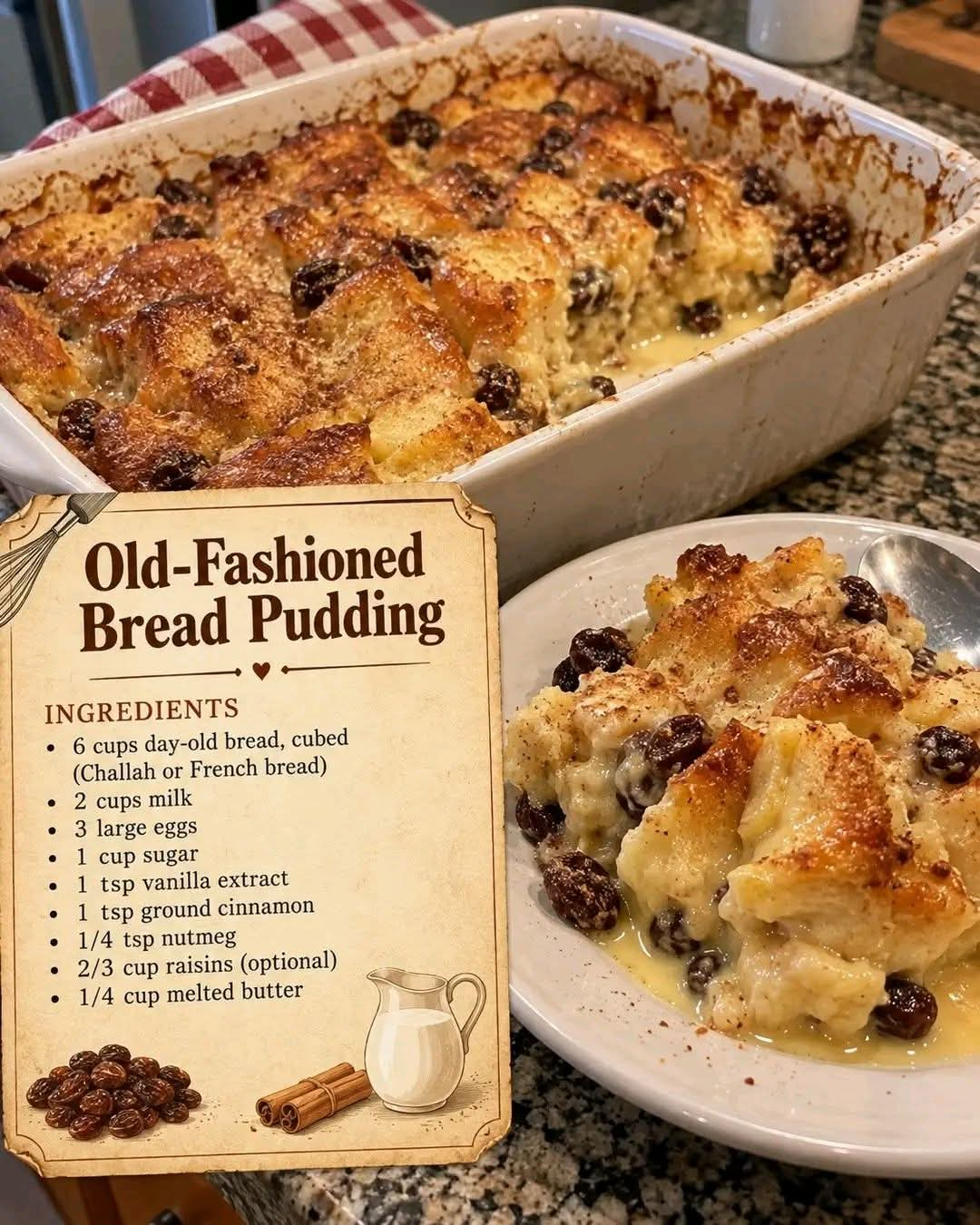
Old-Fashioned Bread Pudding
Introduction
Old-Fashioned Bread Pudding is one of those comforting desserts that proves simple ingredients can create something truly special. Made with day-old bread, milk, eggs, and sugar, this classic pudding transforms humble leftover bread into a warm, soft, custardy dessert with golden edges and a tender center.
Challah or French bread works beautifully because it absorbs the creamy custard without completely falling apart. The result is rich, comforting, lightly sweet, and wonderfully nostalgic. It is the kind of dessert that feels homemade from the very first bite.
This bread pudding is especially delicious served warm, either on its own or with a simple vanilla sauce, caramel sauce, whipped cream, or a scoop of vanilla ice cream.
Ingredients
For the Bread Pudding
- 6 cups day-old bread, cut into cubes
- Challah or French bread
- 2 cups milk
- 3 large eggs
- 1 cup granulated sugar
- 1 teaspoon vanilla extract
- 1/2 teaspoon ground cinnamon
- 1/4 teaspoon ground nutmeg
- 1/4 teaspoon salt
- 2 tablespoons melted butter
Optional Additions
- 1/2 cup raisins
- 1/2 cup chopped pecans or walnuts
- 1 tablespoon brown sugar for the top
- A little extra cinnamon for sprinkling
- Powdered sugar for serving
Instructions
1. Prepare the Bread
Cut the day-old challah or French bread into bite-sized cubes. If the bread is not very dry, spread the cubes on a baking sheet and let them sit uncovered for a little while.
Using slightly stale bread is important because it absorbs the custard much better than fresh, soft bread.
Place the bread cubes into a large mixing bowl and set aside.
2. Prepare the Custard
In another large bowl, whisk together the eggs and sugar until well combined.
Add the milk, vanilla extract, cinnamon, nutmeg, and salt. Whisk until the mixture is smooth and the sugar has begun to dissolve.
Finally, whisk in the melted butter.
3. Combine the Bread and Custard
Pour the prepared custard evenly over the bread cubes.
Using a large spoon or spatula, gently toss the bread so every piece becomes coated with the custard.
Allow the mixture to rest for about 10 to 15 minutes. During this time, the bread will absorb the milk and egg mixture, becoming soft and flavorful.
If using raisins or chopped nuts, gently fold them into the mixture.
4. Prepare the Baking Dish
Preheat the oven to 350°F (175°C).
Grease an approximately 9-by-13-inch baking dish with butter.
Transfer the soaked bread mixture into the prepared dish. Spread it evenly and gently press the bread down so the mixture forms an even layer.
For a slightly sweeter, more golden top, sprinkle a little brown sugar and cinnamon over the surface.
5. Bake the Bread Pudding
Place the baking dish in the preheated oven.
Bake for approximately 40 to 50 minutes, or until the center is set and the top is lightly golden brown.
The pudding should be soft and moist in the middle but should not look liquid or completely unset.
Avoid overbaking because excessive baking can make the pudding dry.
6. Rest Before Serving
Remove the bread pudding from the oven and allow it to rest for about 10 minutes.
This short resting period allows the custard to finish setting while keeping the interior soft and creamy.
Serve warm for the classic old-fashioned experience.
Method
The traditional method begins with stale bread because its slightly dry texture allows it to absorb more custard. The bread is soaked in a simple mixture of milk, eggs, sugar, and flavorings. Once thoroughly softened, it is transferred to a buttered baking dish and baked until the custard sets and the surface becomes golden.
The most important part of the method is giving the bread enough time to absorb the custard. If the bread is baked immediately after the liquid is added, some pieces may remain dry while others become overly saturated.
For the best texture, the finished pudding should have lightly browned edges and a soft, moist center.
History of Bread Pudding
Bread pudding has a long history in home cooking and is closely associated with the idea of avoiding food waste. Throughout different periods and regions, leftover bread was too valuable to simply throw away, so cooks found ways to transform it into nourishing and satisfying dishes.
Bread combined with milk, eggs, and sweeteners became a natural foundation for a baked pudding. Different families developed their own versions, adding ingredients such as raisins, spices, dried fruit, nuts, or sauces.
The dessert became especially popular as a practical home-style dish because it required inexpensive ingredients and could be adapted according to whatever was available in the kitchen.
Today, bread pudding remains a beloved comfort food, particularly in traditional American and European-inspired home cooking.
Formation of the Dish
The formation of this bread pudding happens in several stages.
First, the bread absorbs the milk and egg custard. As it rests, the dry bread becomes soft and flavorful.
During baking, the eggs coagulate and transform the liquid custard into a tender, creamy structure. At the same time, the exposed pieces of bread become golden and slightly crisp around the edges.
The sugar caramelizes lightly on the surface, while cinnamon and nutmeg provide the familiar warm flavor associated with traditional bread pudding.
The finished dessert therefore has several textures at once: golden edges, a tender interior, and soft pieces of bread throughout.
Serving Suggestions
Old-Fashioned Bread Pudding is delicious while still warm.
For a simple presentation, dust the top with powdered sugar.
For something richer, serve each portion with vanilla ice cream. The contrast between the warm pudding and cold ice cream is especially delicious.
You can also serve it with:
- Warm caramel sauce
- Vanilla custard sauce
- Whipped cream
- Fresh berries
- Powdered sugar
- A drizzle of maple syrup
- Chopped toasted pecans
Tips for the Best Bread Pudding
Use day-old bread whenever possible. Slightly stale bread absorbs the custard more effectively.
Do not cut the bread into extremely small pieces. Medium-sized cubes provide a better texture and prevent the pudding from becoming overly dense.
Allow the bread to soak before baking. This ensures that the custard reaches the center of the bread.
Do not overbake. The center should be set but still tender and moist.
For extra flavor, add raisins, pecans, walnuts, or a small amount of dried fruit.
For a richer pudding, part of the milk can be replaced with half-and-half or heavy cream.
Variations
Raisin Bread Pudding
Add 1/2 cup raisins to the soaked bread mixture. The raisins become soft and sweet during baking.
Cinnamon Pecan Bread Pudding
Fold chopped pecans into the mixture and add a little extra cinnamon. The nuts provide a pleasant contrast to the soft pudding.
Apple Bread Pudding
Add small pieces of peeled apple to the bread mixture. Apples pair particularly well with cinnamon and nutmeg.
Chocolate Bread Pudding
Add chocolate chips to the mixture before baking for a richer dessert.
Caramel Bread Pudding
Serve the finished pudding with warm caramel sauce for a deeply sweet and comforting variation.
Conclusion
Old-Fashioned Bread Pudding is a beautiful example of traditional home cooking. A few simple ingredients come together to create a dessert that is warm, tender, creamy, and deeply comforting.
Its greatest charm is its simplicity. Day-old bread that might otherwise be forgotten becomes the foundation for a memorable dessert. The combination of milk, eggs, sugar, vanilla, cinnamon, and nutmeg creates a familiar flavor that feels timeless.
Whether served after a family dinner, prepared for a holiday gathering, or enjoyed as a cozy afternoon dessert, this bread pudding is the kind of recipe that brings warmth to the table.
For Bread Pudding Lovers
If you love classic desserts with a homemade character, this recipe is especially satisfying. It has the nostalgic quality of something prepared in a family kitchen, where leftover ingredients were never wasted and simple recipes were passed from one generation to another.
Bread pudding lovers can also customize it endlessly. Add raisins for sweetness, nuts for crunch, apples for freshness, or caramel sauce for extra richness. The basic recipe remains the same while allowing plenty of room for personal touches.
The best part is that this dessert does not need complicated techniques or expensive ingredients. It is simple, economical, and comforting, making it a wonderful recipe to keep in your collection.
Final Method Summary
- Cut 6 cups of day-old challah or French bread into cubes.
- Whisk together milk, eggs, sugar, vanilla, cinnamon, nutmeg, salt, and melted butter.
- Pour the custard over the bread.
- Let the bread soak for 10 to 15 minutes.
- Transfer the mixture to a greased baking dish.
- Sprinkle with optional cinnamon and brown sugar.
- Bake at 350°F (175°C) for 40 to 50 minutes.
- Remove when the center is set and the top is golden.
- Rest for about 10 minutes.
- Serve warm with powdered sugar, caramel sauce, whipped cream, or vanilla ice cream.