
🥓🧀 Bacon & Smoked Gouda Sourdough Bread
Crispy Crust • Open, Even Crumb • Smoky Cheese • Savory Bacon
🌾 Introduction
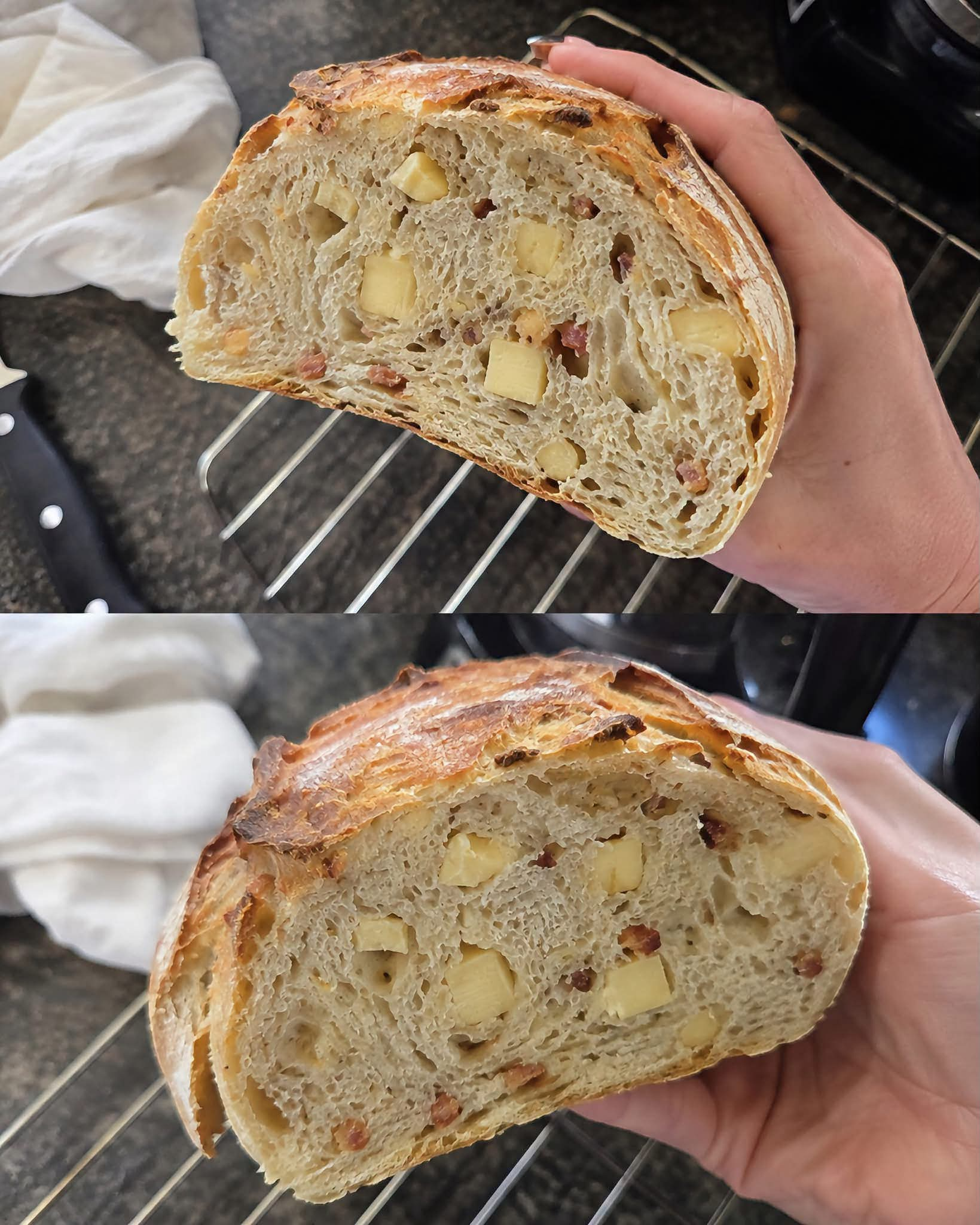
Is THIS the crumb you’ve been trying to achieve?! 😂
This Bacon & Smoked Gouda Sourdough Loaf is the kind of bread that makes you stop cutting, stare at the crumb, and proudly ask, “Did I finally make a decent loaf?”
The answer is: yes! 🎉
A good sourdough crumb doesn’t have to contain enormous holes from edge to edge. For a loaf packed with bacon and cheese, an even, well-developed crumb with a mixture of small and medium air pockets can be exactly what you’re looking for.
The smoky Gouda melts into little pockets throughout the bread while the bacon adds salty, savory, crispy pieces. Together with the tangy sourdough, the result is incredibly flavorful.
It’s fantastic toasted, made into grilled cheese, served with soup, or simply eaten warm with a little butter.
🥖 Ingredients
For the sourdough dough
- 500 g bread flour
- 350 g water
- 100 g active sourdough starter, 100% hydration
- 10 g fine sea salt
- 10 g honey or maple syrup, optional
- 15 g olive oil or melted butter, optional
For the filling
- 180–200 g bacon
- 150–180 g smoked Gouda, cut into small cubes
- 50–75 g additional smoked Gouda, shredded, optional
- ½ teaspoon freshly cracked black pepper
- ½ teaspoon garlic powder, optional
- 1 tablespoon chopped fresh chives or green onions, optional
For baking
- Rice flour or bread flour for dusting
- Parchment paper
- Dutch oven or covered baking vessel
🥓 Preparing the Bacon
Begin by cooking the bacon until it is crisp but not burned.
Transfer it to a paper towel-lined plate and allow it to cool completely.
Once cooled, chop it into small pieces.
Important tip:
Don’t add hot bacon to your dough.
Hot bacon can warm the dough and interfere with fermentation. Excess bacon grease can also make the dough feel unusually slippery and difficult to handle.
For an especially clean crumb, drain the bacon very well before adding it.
🧀 Preparing the Smoked Gouda
Cut the Gouda into approximately ½-inch cubes.
Small cubes distribute beautifully throughout the loaf without creating enormous weak spots in the dough.
You can also shred some Gouda if you want more melted cheese throughout the loaf.
Keep the cheese chilled until you’re ready to incorporate it.
🌾 Method 1: Mixing the Dough
Add the water and active sourdough starter to a large mixing bowl.
Stir until the starter is mostly dispersed.
Add the bread flour and mix until there are no obvious dry patches.
The dough will look rough and shaggy at this stage.
Cover and let it rest for approximately 30–60 minutes.
This resting period is commonly called autolyse when flour and water are rested before the remaining ingredients are incorporated.
🧂 Adding the Salt
After the rest, add the salt.
If using honey and olive oil, add them now as well.
Work everything into the dough using your hands.
Pinch, fold, and squeeze the dough gently until the ingredients are evenly incorporated.
The dough should gradually become smoother and more elastic.
💪 Method 2: Building Gluten Strength
Instead of aggressively kneading the dough, use a series of stretch-and-folds.
Every 30 minutes:
- Wet your hands.
- Grab one side of the dough.
- Stretch it upward gently.
- Fold it over the center.
- Rotate the bowl.
- Repeat on all four sides.
Perform approximately 3–5 rounds of stretch-and-folds.
As fermentation continues, the dough should become:
- smoother
- stronger
- more elastic
- less sticky
- better able to hold its shape
🥓🧀 Method 3: Adding the Bacon & Gouda
Add the cooled bacon and smoked Gouda during one of the later folds.
Gently flatten the dough into a rough rectangle.
Scatter approximately half of the bacon and cheese over the surface.
Fold the dough over itself.
Add the remaining filling and fold again.
Try to distribute the filling rather than squeezing it aggressively into one area.
Don’t worry if a few pieces poke through.
That’s part of the beauty of a rustic cheese-and-bacon loaf!
🌡️ Method 4: Bulk Fermentation
Cover the dough and allow it to ferment at room temperature.
The exact time depends on:
- starter strength
- room temperature
- flour
- dough temperature
- hydration
Rather than relying entirely on the clock, watch the dough.
You’re looking for a dough that has become noticeably:
- puffier
- lighter
- smoother
- elastic
- slightly domed
- filled with visible bubbles around the edges
Depending on your conditions, bulk fermentation might take approximately 4–7 hours.
Don’t necessarily wait for the dough to double.
For sourdough, a moderate increase in volume can be enough.
🍞 Method 5: Pre-Shaping
Turn the fermented dough onto a lightly floured surface.
Gently shape it into a round.
Try not to completely destroy all the gas you’ve worked so hard to develop.
Let the dough rest uncovered for approximately 15–30 minutes.
This gives the gluten time to relax.
🥖 Method 6: Final Shaping
For a round boule:
- Gently stretch the dough into a rough circle.
- Fold the bottom toward the center.
- Fold the sides inward.
- Roll or fold the dough toward the top.
- Flip it seam-side down.
- Use your hands or a bench scraper to create surface tension.
The outside should feel tight and smooth.
That surface tension helps the loaf rise upward instead of spreading outward.
❄️ Method 7: Cold Proof
Place the shaped loaf into a well-floured banneton or bowl lined with a floured cloth.
Cover it.
Refrigerate for approximately 8–16 hours.
This slow fermentation develops flavor and makes the dough easier to score and bake.
The chilled dough also helps keep the bacon and cheese from becoming too messy during scoring.
🔥 Method 8: Baking
Preheat your Dutch oven and oven to approximately:
475°F / 245°C
Allow the baking vessel to heat thoroughly.
When you’re ready to bake, carefully turn the cold loaf onto parchment paper.
Dust away excess flour.
Score the top with a sharp bread lame or razor.
A simple single slash works beautifully.
Carefully transfer the loaf into the hot Dutch oven.
Bake:
20 minutes covered at 475°F / 245°C
Then remove the lid.
Reduce the temperature to approximately:
440°F / 225°C
Continue baking for another 20–30 minutes, or until the crust is deeply golden brown.
Because the loaf contains cheese and bacon, keep an eye on the crust toward the end.
If the cheese starts browning too quickly, reduce the temperature slightly.
🌬️ The Most Important Step: Cooling
I know.
You smell bacon.
You see melted Gouda.
The loaf is sitting there looking absolutely irresistible.
BUT WAIT! 😂
Let the loaf cool on a wire rack for at least 1–2 hours before slicing.
Cutting sourdough too early can compress the crumb and make the interior appear gummy.
The bread continues setting as it cools.
🔪 How Should the Crumb Look?
This is where the excitement is justified! 😂
For this particular loaf, you’re looking for:
✅ Good signs
- Even distribution of air pockets
- Small-to-medium irregular holes
- Soft, elastic interior
- No large dense bands
- No gummy streaks
- Dough that has risen well
- Bacon and cheese distributed throughout
- A crust that is deeply browned and crisp
You do not need gigantic holes everywhere to have a successful sourdough.
In fact, an extremely open crumb isn’t always desirable for a loaded loaf.
With bacon and cheese, a moderately open and even crumb can actually be more practical because it gives the loaf enough structure to hold all those delicious additions.
🧠 Why Did the Crumb Turn Out This Way?
The crumb is influenced by several things.
1. Gluten development
Strong gluten creates a network capable of trapping fermentation gases.
2. Fermentation
Under-fermentation can create a dense loaf with uneven holes.
Over-fermentation can cause the dough to lose strength and spread.
3. Hydration
More water can encourage a more open crumb, but higher hydration also makes the dough more challenging to handle.
4. Shaping
Good shaping creates surface tension and helps organize the internal structure.
5. Handling
Aggressive handling can knock out valuable gas bubbles.
6. Add-ins
Bacon and cheese add weight to the dough, so the crumb may naturally be slightly tighter than a plain sourdough loaf.
That’s completely normal.
🧀🔥 Formation of the Perfect Loaf
The formation of this bread is really a combination of fermentation, gluten development, shaping, and heat.
During fermentation, the sourdough starter produces carbon dioxide.
The gluten network traps those gases.
As the dough enters the oven, the gases expand rapidly, producing oven spring.
The heat then sets the structure of the bread.
Meanwhile, the Gouda melts into the dough and the bacon releases its wonderful smoky, salty flavor.
The result is a loaf with:
Crispy crust + chewy crumb + smoky cheese + savory bacon = perfection.
📜 A Little History
Sourdough itself has an incredibly long history.
Before commercial baker’s yeast became widely available, naturally fermented dough was one of the traditional ways people leavened bread.
Natural fermentation relies on wild yeasts and lactic-acid bacteria living in a starter culture.
Bacon and cheese, meanwhile, have long been natural companions to bread because they provide salt, fat, protein, and intense savory flavor.
Smoked cheeses such as smoked Gouda add another layer of flavor, giving a traditional fermented loaf a modern, indulgent twist.
Today, sourdough bakers love experimenting with additions such as:
- cheddar
- Parmesan
- Gruyère
- Gouda
- roasted garlic
- jalapeños
- olives
- herbs
- caramelized onions
- bacon
And this bacon-and-smoked-Gouda combination is especially hard to resist.
❤️ For the Lovers of Savory Bread
If you’re a person who loves:
🥓 Bacon
🧀 Melted cheese
🥖 Fresh bread
🔥 Crispy crusts
🌾 Sourdough
😋 Savory breakfasts
this loaf was practically made for you.
Try serving it warm with butter.
Or toast thick slices and top them with scrambled eggs.
Or turn it into the ultimate grilled cheese sandwich.
You can even serve it alongside tomato soup, potato soup, chili, or a hearty salad.
💡 Expert Tips for an Even Better Loaf
Tip 1: Use an active starter
Your starter should be bubbly, active, and capable of rising strongly after feeding.
Tip 2: Don’t overload the dough
It’s tempting to add mountains of bacon and cheese.
But too many inclusions can weaken the dough structure.
Tip 3: Cool your fillings
Cold or room-temperature bacon and cheese are much easier to incorporate.
Tip 4: Don’t chase giant holes
A beautiful crumb is about structure, not simply hole size.
Tip 5: Watch fermentation
Learn to read the dough rather than relying exclusively on a recipe’s timing.
Tip 6: Create surface tension
A properly shaped loaf will usually hold its form much better in the oven.
Tip 7: Bake thoroughly
A loaf with cheese and bacon needs enough time to develop a deeply baked crust and properly set interior.
🥪 Serving Ideas
🥓 Breakfast Toast
Toast a thick slice and top it with a fried egg.
🧀 Ultimate Grilled Cheese
Use two thick slices with extra smoked Gouda.
🍅 Soup Companion
Serve alongside tomato soup or creamy potato soup.
🧈 Simple & Classic
Warm bread + salted butter.
🥪 Savory Sandwich
Add turkey, lettuce, tomato, and a little mustard.
🍳 Brunch
Serve toasted slices alongside eggs and fresh fruit.
🧊 Storage
Once completely cool, store the loaf at room temperature in a bread bag or wrapped in a clean kitchen towel.
For longer storage, slice the loaf and freeze it.
Place parchment between slices if you want to remove individual pieces easily.
Toast directly from frozen for a quick breakfast.
📝 Final Thoughts
So… did you finally make a decent loaf?
Absolutely! 😂🥖
Based on the crumb description, an evenly developed interior with the bacon and smoked Gouda nicely distributed sounds like a very promising sourdough result.
And remember: don’t judge your sourdough only by whether it has huge Instagram-style holes.
A successful loaf should have good fermentation, strength, structure, flavor, and texture.
If it tastes delicious, has a crisp crust, a pleasantly chewy interior, and the inclusions are distributed throughout, you’ve got something worth celebrating.
Now slice it thick, toast it, add a little butter, and enjoy the loaf you worked so hard for.
Bacon + smoked Gouda + sourdough = a loaf worth getting excited about. ❤️🥓🧀🥖
❤️ Final Rating:
Crumb: ⭐⭐⭐⭐⭐
Flavor: ⭐⭐⭐⭐⭐
Cheese factor: ⭐⭐⭐⭐⭐
Bacon factor: ⭐⭐⭐⭐⭐
Crust: ⭐⭐⭐⭐⭐
“I should probably make another loaf”: ⭐⭐⭐⭐⭐⭐⭐⭐⭐⭐ 😂