
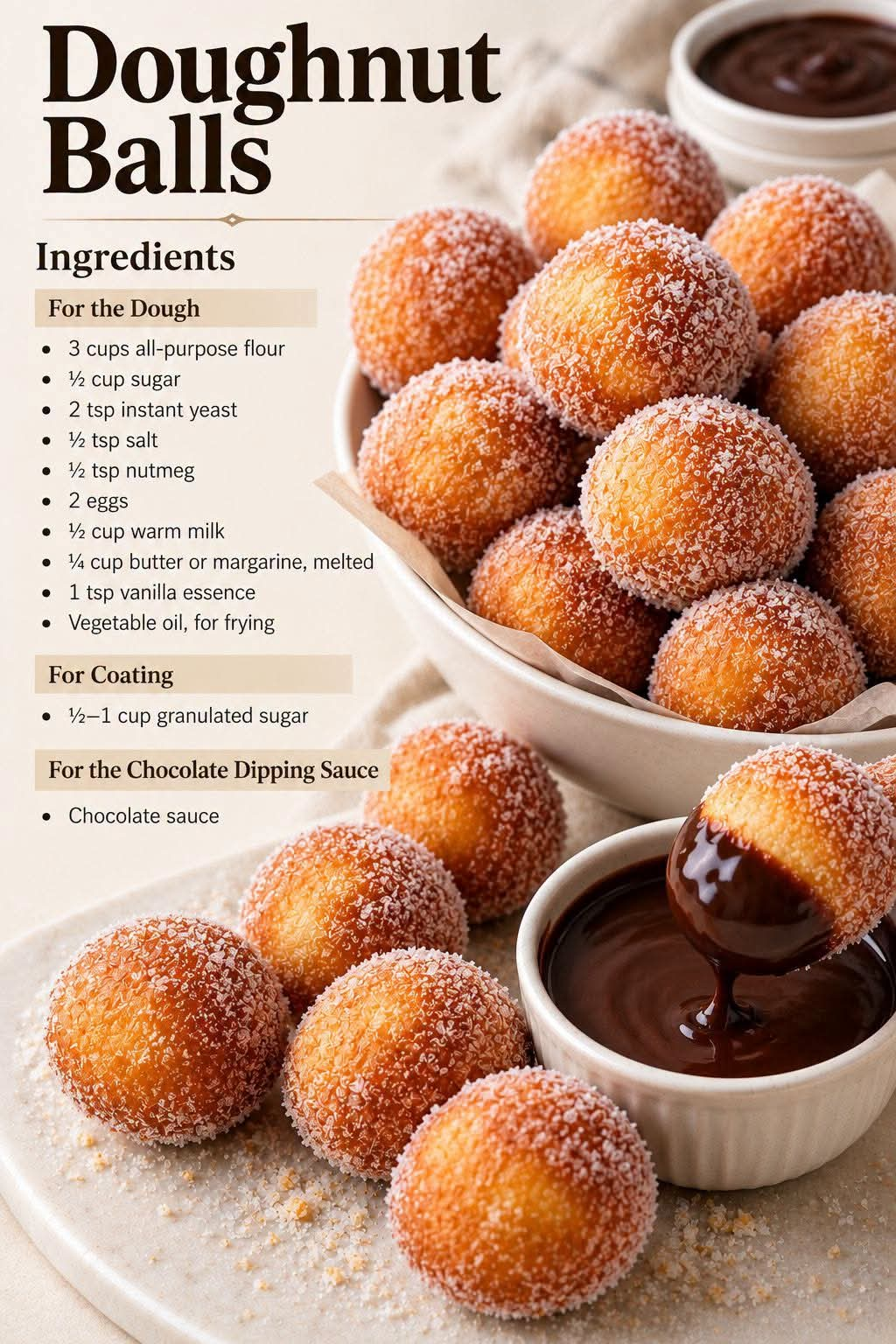
Doughnut Balls
Introduction
Doughnut Balls are soft, fluffy, golden little treats made from a lightly sweetened yeast dough, fried until beautifully golden, then coated generously in granulated sugar. Their small, bite-sized shape makes them especially fun to serve at breakfast, afternoon tea, family gatherings, parties, bake sales, or simply as a homemade dessert.
The dough is enriched with eggs, milk, butter, and vanilla, while a small amount of nutmeg adds a warm, traditional bakery flavor. Once fried, the doughnut balls develop a delicate crisp exterior while remaining soft and tender inside. Served warm with chocolate dipping sauce, they become an irresistible combination of fluffy dough, crunchy sugar, and rich chocolate.
Ingredients
For the Dough
- 3 cups all-purpose flour
- 1/2 cup granulated sugar
- 2 teaspoons instant yeast
- 1/2 teaspoon salt
- 1/2 teaspoon ground nutmeg
- 2 large eggs
- 1/2 cup warm milk
- 1/4 cup butter or margarine, melted and slightly cooled
- 1 teaspoon vanilla essence
- Vegetable oil, for deep frying
For the Sugar Coating
- 1/2 to 1 cup granulated sugar
For the Chocolate Dipping Sauce
- Chocolate sauce, homemade or store-bought
Equipment
- Large mixing bowl
- Wooden spoon or spatula
- Measuring cups and spoons
- Clean work surface
- Kitchen towel or plastic wrap
- Deep, heavy-bottomed saucepan or deep fryer
- Slotted spoon
- Paper towels
- Large plate or bowl for coating
Preparation
Before beginning, make sure all of your ingredients are measured and ready. The milk should be warm rather than hot. Very hot milk can interfere with the yeast and prevent the dough from rising properly.
Melt the butter and allow it to cool slightly before adding it to the dough. Prepare a clean, lightly floured work surface and have your frying equipment ready.
Method
Step 1: Combine the Dry Ingredients
Place the flour, granulated sugar, instant yeast, salt, and ground nutmeg in a large mixing bowl.
Whisk or stir the ingredients together thoroughly so the yeast, salt, sugar, and nutmeg are evenly distributed throughout the flour.
Step 2: Add the Wet Ingredients
Make a well in the center of the dry ingredients.
Add the eggs, warm milk, melted butter, and vanilla essence. Begin mixing from the center, gradually incorporating the flour from the sides.
Continue mixing until a soft, slightly sticky dough begins to form.
Step 3: Knead the Dough
Transfer the dough to a lightly floured surface and knead for approximately 8 to 10 minutes, or until it becomes smooth, elastic, and soft.
If the dough feels extremely sticky, add a small amount of flour at a time. Avoid adding too much flour because a very stiff dough can produce heavy, dense doughnut balls.
The finished dough should feel soft and supple.
Step 4: First Rise
Place the dough in a lightly greased bowl. Turn it once so the surface is lightly coated.
Cover the bowl with a clean kitchen towel or plastic wrap.
Leave the dough in a warm, draft-free place for approximately 1 to 1 1/2 hours, or until it has roughly doubled in size.
The exact rising time will depend on the temperature of your kitchen.
Step 5: Shape the Doughnut Balls
Once the dough has doubled, gently press it down to release excess air.
Divide the dough into small, approximately equal portions.
Roll each portion between your palms to form a smooth ball. Try to keep the balls similar in size so they cook evenly.
Place the shaped balls on a lightly floured or greased tray, leaving a little space between them.
Cover loosely and allow them to rest for another 15 to 20 minutes.
Step 6: Heat the Oil
Pour enough vegetable oil into a deep, heavy-bottomed saucepan to allow the doughnut balls to float freely.
Heat the oil over medium heat.
The ideal frying temperature is approximately 170–175°C (340–350°F).
If the oil is too hot, the outside will brown quickly while the center remains undercooked. If the oil is too cool, the doughnut balls can absorb excessive oil and become greasy.
Step 7: Fry the Doughnut Balls
Carefully place several doughnut balls into the hot oil, making sure not to overcrowd the pan.
Fry them for approximately 3 to 5 minutes, gently turning them with a slotted spoon so they become evenly golden brown on all sides.
The exact cooking time will depend on their size.
Once golden brown and cooked through, remove them from the oil with a slotted spoon.
Place them on a plate lined with paper towels to absorb excess oil.
Continue frying the remaining doughnut balls in batches.
Step 8: Coat With Sugar
While the doughnut balls are still warm, place them in a bowl containing the granulated sugar.
Toss gently until each doughnut ball is completely covered.
For a thicker sugar coating, toss them twice while they are still warm.
Step 9: Prepare the Chocolate Dip
Pour chocolate sauce into a small serving bowl.
For a richer homemade dipping sauce, warm chocolate with a little cream or milk until smooth and glossy. Allow it to cool slightly before serving.
Step 10: Serve
Arrange the warm, sugar-coated doughnut balls on a serving platter.
Place the chocolate dipping sauce alongside them.
Serve immediately while the doughnut balls are soft and warm.
The Formation of the Doughnut Balls
The texture of these doughnut balls depends on several important stages.
The yeast gives the dough its characteristic light and airy structure. During fermentation, the yeast produces carbon dioxide, which becomes trapped within the developing gluten network. This causes the dough to expand and gives the finished doughnut balls their fluffy interior.
Kneading develops the gluten, helping the dough hold the gases produced during fermentation. The second resting period allows the shaped balls to become lighter before they enter the hot oil.
During frying, the moisture inside the dough turns into steam while the exterior develops a golden-brown crust. This creates the contrast between the lightly crisp outside and soft, tender center.
Finally, coating the doughnut balls while warm helps the sugar adhere to the surface.
History and Background
Small fried dough treats have existed in many cultures for generations. Different regions have developed their own versions using combinations of flour, eggs, milk, yeast, spices, sugar, and other ingredients.
The concept of a small fried dough ball is particularly popular across many African communities, where versions may be prepared for breakfast, celebrations, family gatherings, street-food stalls, and special occasions. Similar fried dough preparations can also be found throughout Europe, Asia, and the Americas.
The exact ingredients and names vary from one household and region to another. Some recipes use yeast for a light, bread-like texture, while others rely on baking powder or baking soda for a quicker preparation.
This yeast-raised version combines traditional fried-dough techniques with a simple sugar coating and chocolate sauce, creating a modern and family-friendly dessert.
Important Tips for Perfect Doughnut Balls
Keep the Dough Soft
Do not add excessive flour. A soft dough generally produces lighter and more tender doughnut balls.
Give the Dough Enough Time to Rise
The first rise is important for developing a fluffy texture. If your kitchen is cool, the dough may require additional time.
Keep the Dough Balls Similar in Size
Uniform portions ensure that all the doughnut balls finish cooking at approximately the same time.
Maintain the Oil Temperature
Consistent oil temperature is one of the most important parts of successful frying. Medium heat is a good starting point, but adjust it as necessary.
Do Not Overcrowd the Pan
Adding too many doughnut balls at once can lower the oil temperature and cause uneven cooking.
Drain Properly
Allow the fried doughnut balls to drain briefly on paper towels before coating them with sugar.
Coat While Warm
Sugar sticks much better when the doughnut balls are still warm.
Variations
Cinnamon Sugar Doughnut Balls
Mix granulated sugar with ground cinnamon and use it instead of plain sugar for a warm, spiced coating.
Vanilla Sugar Doughnut Balls
Add a small amount of vanilla sugar or finely ground vanilla to the coating.
Chocolate-Covered Doughnut Balls
Instead of simply serving chocolate sauce on the side, dip one side of each doughnut ball into melted chocolate and allow it to set.
Coconut Doughnut Balls
Add finely grated coconut to the sugar coating for a tropical variation.
Powdered Sugar Doughnut Balls
Replace granulated sugar with powdered sugar for a softer, delicate finish.
Nutty Chocolate Doughnut Balls
Dip the doughnut balls into chocolate sauce and sprinkle with finely chopped roasted nuts.
Serving Suggestions
Doughnut balls are delicious served warm with chocolate sauce, but there are many other possibilities.
Serve them with:
- Chocolate ganache
- Caramel sauce
- Vanilla glaze
- Strawberry sauce
- Honey
- Cinnamon sugar
- Powdered sugar
- Peanut butter sauce
- Fresh fruit
- Whipped cream
- Ice cream
They can also be arranged on a large platter with several dipping sauces, making them an excellent dessert for parties and family gatherings.
Make-Ahead and Storage
Doughnut balls are best enjoyed fresh and warm.
If you have leftovers, allow them to cool completely before placing them in an airtight container. They can generally be kept at room temperature for up to 1 to 2 days.
For the best texture, gently reheat them before serving. A few seconds in the microwave can soften them again, although freshly fried doughnut balls will always have the best texture.
The sugar coating may gradually dissolve into the surface during storage, so additional sugar can be added after reheating.
Common Problems and Solutions
Doughnut Balls Are Dense
This may happen if the dough was not kneaded sufficiently, the yeast was inactive, or the dough did not have enough time to rise.
Doughnut Balls Are Too Greasy
The oil may not have been hot enough, or too many doughnut balls may have been fried at once.
Outside Is Brown but Inside Is Raw
The oil was probably too hot. Reduce the heat and fry the next batch more slowly.
Dough Is Too Sticky
Add flour gradually, using only enough to make the dough manageable. Avoid turning it into a stiff dough.
Sugar Does Not Stick
Make sure the doughnut balls are still warm when coating them. If they have cooled completely, the sugar will have difficulty adhering.
Conclusion
These Doughnut Balls are a wonderful example of how simple ingredients can become a special homemade treat. The combination of soft yeast-raised dough, warm nutmeg, buttery richness, golden fried edges, sweet sugar coating, and creamy chocolate sauce makes every bite satisfying.
They are easy enough for a family weekend breakfast yet special enough for celebrations, parties, bake sales, and gatherings. The recipe can also be adapted with different coatings, fillings, spices, and dipping sauces, allowing you to create your own favorite version.
For the best experience, serve them freshly fried, lightly coated with sugar, and accompanied by plenty of chocolate dipping sauce.
For Doughnut Lovers
For anyone who loves doughnuts, these bite-sized treats offer something especially enjoyable: there is no need to slice or decorate a large doughnut. Each little ball is individually golden, soft, sweet, and ready to dip.
Doughnut lovers can experiment with different toppings and sauces to create a dessert platter with several flavors. A bowl of cinnamon sugar, a bowl of powdered sugar, chocolate sauce, caramel, and strawberry sauce can turn these simple doughnut balls into an impressive dessert station.
The real charm of this recipe is its simplicity. Homemade dough, a little patience, careful frying, and a generous coating of sugar are all it takes to create a batch of warm, comforting doughnut balls that are difficult to resist.
Final Method at a Glance
- Combine flour, sugar, yeast, salt, and nutmeg.
- Add eggs, warm milk, melted butter, and vanilla.
- Mix and knead until a soft, smooth dough forms.
- Cover and let rise until doubled.
- Divide into small portions and roll into smooth balls.
- Rest the shaped dough balls briefly.
- Heat vegetable oil to approximately 170–175°C.
- Fry in small batches until evenly golden and cooked through.
- Drain briefly on paper towels.
- Toss the warm doughnut balls in granulated sugar.
- Serve warm with chocolate dipping sauce.
- Enjoy fresh for the softest, fluffiest texture.