
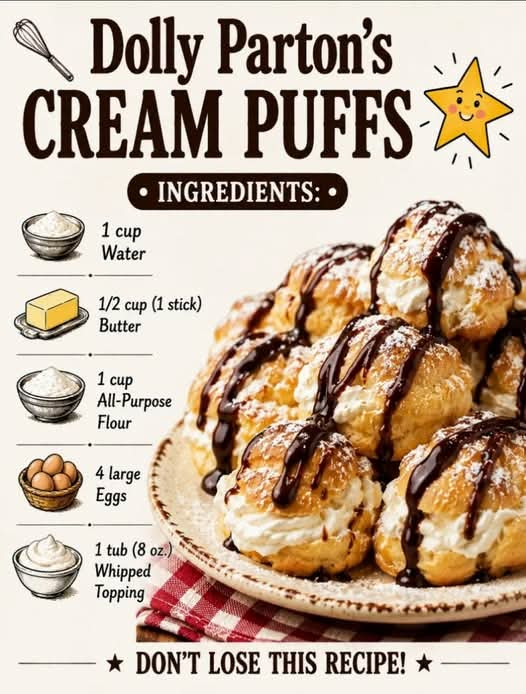
Dolly Parton’s Cream Puffs
Introduction
Cream puffs are one of those classic desserts that look elegant and impressive but are surprisingly simple to make at home. Light, golden pastry shells are baked until beautifully puffed and hollow inside, then filled with soft, sweet whipped cream. The contrast between the crisp exterior and creamy center makes every bite wonderfully satisfying.
This recipe uses a traditional choux pastry made with water, butter, flour, and eggs. The dough does not require yeast or a separate rising period. Instead, the moisture in the dough creates steam in the oven, which causes the pastries to expand and form their characteristic airy centers.
Although this recipe is often shared online as “Dolly Parton’s Cream Puffs,” it is best understood as a Dolly-inspired or attributed recipe rather than a verified signature recipe from Dolly Parton herself. The dessert fits beautifully with the warm, nostalgic Southern-style baking tradition associated with her public image and cooking culture.
Ingredients
For the Cream Puffs
- 1 cup water
- 1/2 cup unsalted butter
- 1 cup all-purpose flour
- 4 large eggs
- 1/4 teaspoon salt
- 1 teaspoon vanilla extract, optional
For the Whipped Cream Filling
- 1 cup heavy whipping cream
- 1/2 cup powdered sugar
- 1 teaspoon vanilla extract
Optional Finishing
- Powdered sugar for dusting
- Fresh berries
- Chocolate or caramel sauce
- Thinly sliced strawberries or bananas
Instructions
Step 1: Prepare the Oven
Preheat the oven to 400°F (200°C). Line a large baking sheet with parchment paper.
It is important to have the oven fully preheated before the pastry goes inside. The initial high temperature helps create the steam necessary for the cream puffs to rise.
Step 2: Make the Choux Pastry
Place the water and butter in a medium saucepan over medium heat. Add the salt and bring the mixture to a full simmer, making sure the butter has completely melted.
Once the butter and water are hot, remove the saucepan briefly from the heat and add the flour all at once.
Stir vigorously with a wooden spoon or sturdy spatula until the flour is completely incorporated and a thick dough forms.
Step 3: Cook the Dough
Return the saucepan to low or medium-low heat. Continue stirring the dough for approximately 1 to 2 minutes.
The dough should begin pulling away from the sides of the pan and form a smooth ball. This step helps remove excess moisture and prepares the dough to absorb the eggs properly.
Transfer the dough to a mixing bowl and allow it to cool for several minutes.
The dough should be warm but not extremely hot before the eggs are added.
Step 4: Add the Eggs
Add the eggs one at a time, mixing thoroughly after each addition.
At first, the dough may appear separated or slippery. Continue mixing until each egg is completely incorporated before adding the next.
The finished dough should be smooth, glossy, and thick enough to hold its shape when piped.
Add vanilla extract if desired.
Step 5: Form the Cream Puffs
Transfer the pastry dough to a piping bag fitted with a large round tip.
Pipe small mounds onto the prepared baking sheet, leaving about 2 inches of space between each one.
For evenly sized cream puffs, pipe each mound approximately 1 1/2 to 2 inches wide.
If the tops have a small point, gently smooth them with a damp fingertip.
Step 6: Bake
Place the baking sheet in the preheated oven and bake at 400°F for approximately 15 minutes.
Without opening the oven door, reduce the temperature to 350°F (175°C) and continue baking for another 15 to 20 minutes, or until the pastries are golden brown and firm.
Avoid opening the oven during the early part of baking because a sudden loss of heat can cause the pastries to collapse.
Step 7: Release the Steam
When the cream puffs are deeply golden and feel firm, remove them from the oven.
Use a small knife to make a tiny opening in the side or bottom of each pastry. This allows excess steam to escape.
Return them to the turned-off oven with the door slightly open for approximately 5 minutes. This helps keep the shells crisp and reduces the chance of them becoming soggy.
Transfer them to a wire rack and allow them to cool completely.
Method for the Whipped Cream Filling
Place the cold heavy whipping cream in a chilled mixing bowl.
Begin beating at medium speed. Gradually add the powdered sugar and vanilla extract.
Continue whipping until the cream forms medium-to-stiff peaks.
Be careful not to overbeat the cream, because excessive whipping can cause it to become grainy and eventually turn into butter.
Filling the Cream Puffs
Once the pastry shells have cooled completely, cut each one horizontally or make a small opening in the bottom.
Spoon or pipe the sweetened whipped cream into the center.
For a more generous filling, use a piping bag to fill each puff until the cream reaches the edges.
Replace the tops and lightly dust with powdered sugar.
For an especially attractive presentation, arrange the filled cream puffs on a serving platter and add a few fresh berries around them.
The History of Cream Puffs
Cream puffs belong to the family of pastries known as choux pastry, or pâte à choux. The technique is traditionally associated with French pastry making and has been used for centuries to create light pastries that rise without yeast.
The unusual feature of choux pastry is the way it is prepared. The flour is cooked with water and butter before the eggs are incorporated. When the finished dough enters a hot oven, the water within the dough turns into steam. That steam expands inside the pastry, pushing the dough outward and creating a hollow center.
This simple but clever technique is the foundation for many famous pastries, including profiteroles, éclairs, gougères, and cream puffs.
Cream puffs eventually became popular far beyond France and developed into a beloved homemade dessert in many countries. In American kitchens, they became especially appealing because they require relatively simple pantry ingredients while producing a dessert that looks bakery-quality.
Formation and Texture
The formation of the cream puff depends on several important stages.
First, the butter and water must become sufficiently hot before the flour is added. The flour is then cooked to create the foundation of the dough.
Second, the dough must be dried slightly in the saucepan. If it contains too much moisture before the eggs are added, the final pastry may spread rather than rise properly.
Third, the eggs provide both moisture and structure. They help create the steam that expands the pastry while also contributing to its delicate texture.
Finally, the oven must remain hot enough for the pastry to develop a strong outer shell. Once the pastry has risen, continued baking helps dry the interior and prevent collapse.
The ideal cream puff should be golden on the outside, crisp or lightly tender on the surface, and mostly hollow inside.
Tips for Perfect Cream Puffs
Use room-temperature eggs when possible. They incorporate more easily into the warm dough.
Do not add all the eggs at once. Adding them individually makes it much easier to control the consistency.
Do not make the piped pastries excessively large. Smaller, evenly sized puffs bake more consistently.
Do not open the oven too early. The sudden temperature change can cause the pastries to deflate.
Make sure the shells are completely cool before filling them. Warm pastry can melt the whipped cream.
For the crispest texture, fill the cream puffs shortly before serving.
If preparing them ahead of time, store the empty shells in an airtight container and fill them shortly before serving.
Serving Ideas
These cream puffs are delicious served simply with powdered sugar, but they can also become an impressive dessert for celebrations.
For a fruit-filled version, add sliced strawberries, raspberries, blueberries, or peaches along with the whipped cream.
For a richer dessert, drizzle the finished cream puffs with melted chocolate.
A caramel drizzle adds a warm, buttery sweetness that pairs beautifully with the light pastry.
For holidays and family gatherings, arrange several filled cream puffs into a pyramid and dust the entire dessert with powdered sugar.
They are also wonderful alongside coffee, tea, hot chocolate, or a glass of cold milk.
Make-Ahead Method
The pastry shells can be prepared in advance and stored after they have completely cooled.
If the shells lose some crispness, place them in a 300°F (150°C) oven for several minutes to refresh them. Allow them to cool before filling.
The whipped cream is best prepared close to serving time. Once filled, the cream puffs should be refrigerated if they will not be served immediately.
Common Mistakes to Avoid
One common mistake is adding the eggs while the dough is still extremely hot. This can partially cook the eggs and create an undesirable texture.
Another mistake is underbaking. A cream puff can look beautifully golden on the outside while still containing too much moisture inside. Proper baking and steam release are essential.
Overfilling can also make the pastry difficult to eat and can soften the shell quickly. Fill the center generously but avoid forcing in more cream than the pastry can hold.
Finally, resist the temptation to open the oven repeatedly while the pastries are rising.
Conclusion
These cream puffs are a wonderful example of how a few simple ingredients can be transformed into an elegant homemade dessert. The buttery choux pastry rises into delicate golden shells, while the sweet vanilla whipped cream creates a rich and creamy center.
They are perfect for family gatherings, afternoon desserts, birthdays, holidays, showers, tea parties, or simply whenever you want something special without making a complicated cake.
The recipe also has that timeless homemade quality that makes cream puffs so memorable. They look sophisticated enough for a celebration but are made from ingredients that many home bakers already have in their kitchens.
For Cream Puff Lovers
If you love light pastries, homemade whipped cream, and classic desserts, these cream puffs are a recipe worth keeping. Their neutral pastry shell works beautifully with countless fillings, allowing you to make the recipe your own.
Try them with vanilla cream, chocolate cream, pastry cream, lemon cream, strawberries, bananas, or a combination of fresh fruit and whipped cream.
For a nostalgic presentation, keep the recipe simple: golden pastry, freshly whipped cream, and a generous dusting of powdered sugar. Sometimes the simplest version is the one everyone remembers.
The best part is serving a platter of freshly filled cream puffs and watching everyone reach for one before the others disappear. This is the kind of homemade dessert that can easily become a family favorite and a recipe people ask you to make again and again.