
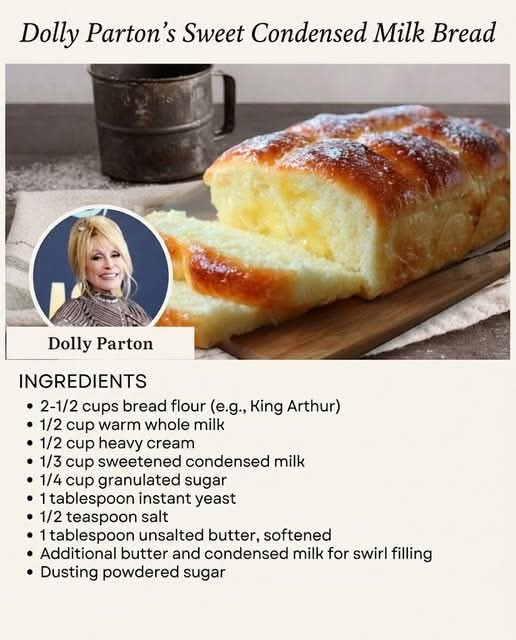
Dolly Parton-Inspired Sweetened Condensed Milk Bread
Absolutely. Here is a large, detailed version written as a comforting Southern-style recipe. One important note: I could not verify that Sweet Condensed Milk Bread is an actual Dolly Parton family recipe. Dolly is well known for Southern cooking and baking, and her official food site features recipes inspired by her culinary traditions, so this is best presented as a Dolly Parton-inspired recipe, rather than an officially endorsed Dolly recipe.
Dolly Parton-Inspired Sweetened Condensed Milk Bread
Introduction
There is something wonderfully comforting about a freshly baked loaf of homemade bread. The smell fills the kitchen, the crust turns beautifully golden, and the inside stays soft enough to pull apart with your fingers.
This Sweetened Condensed Milk Bread takes that classic homemade comfort and adds a little extra richness. Sweetened condensed milk gives the dough a gentle sweetness and contributes to a tender, soft crumb. Similar condensed-milk bread recipes are known for producing fluffy loaves that are excellent for breakfast, toast, sandwiches, French toast, or simply eating warm with butter.
The recipe below is designed as a generous family-style loaf. It has a soft interior, a golden top, and just enough sweetness to make it feel special without becoming dessert-like.
Recipe Overview
Recipe: Sweetened Condensed Milk Bread
Style: Soft Southern-inspired homemade bread
Yield: 2 loaves
Preparation: About 30 minutes
First rise: 1 to 1½ hours
Second rise: 30–45 minutes
Baking: 28–35 minutes
Oven: 350°F (175°C)
Ingredients
For the Bread
- 4 cups all-purpose flour, approximately 500 g
- 2 ¼ teaspoons active dry yeast, one standard 7 g packet
- ¾ cup warm whole milk, about 180 ml
- ½ cup sweetened condensed milk, about 150 g
- ¼ cup granulated sugar, about 50 g
- 1 large egg
- ¼ cup unsalted butter, melted and slightly cooled, about 57 g
- 1 teaspoon salt
- 1 teaspoon vanilla extract
- ¼ cup warm water, only if needed to adjust the dough
For the Egg Wash
- 1 egg
- 1 tablespoon milk
For the Finish
- 1–2 tablespoons melted butter
- 1–2 tablespoons sweetened condensed milk, optional
Equipment
- Large mixing bowl
- Measuring cups and spoons
- Wooden spoon or dough hook
- Stand mixer, optional
- Two 9 x 5-inch loaf pans
- Clean kitchen towel
- Wire cooling rack
- Pastry brush
Instructions
Step 1: Prepare the Yeast
Pour the warm milk into a large bowl.
The milk should feel comfortably warm, not hot. Add the yeast and about 1 tablespoon of the granulated sugar.
Stir gently and allow the mixture to stand for approximately 5–10 minutes.
If using active dry yeast, you should see some foaming on the surface. This is a good indication that the yeast is active.
Step 2: Add the Rich Ingredients
Add the sweetened condensed milk, remaining sugar, egg, melted butter, and vanilla extract.
Whisk or stir until the mixture is well combined.
The condensed milk provides sweetness and richness while the butter and egg help create a tender crumb.
Step 3: Add the Flour
Add approximately 3 cups of the flour and mix until a thick, sticky dough begins to form.
Add the salt.
Gradually add the remaining flour, about ¼ cup at a time.
Do not add all the flour automatically. Depending on humidity, flour brand, and measuring technique, the dough may require slightly more or less.
The finished dough should be soft and slightly tacky but should not be extremely wet.
Step 4: Knead the Dough
Stand Mixer Method
Place the dough hook on your mixer and knead on low speed for about 5 minutes.
Increase to medium-low speed and continue kneading for another 3–5 minutes.
The dough should become smoother, elastic, and slightly springy.
By-Hand Method
Transfer the dough to a lightly floured work surface.
Knead for approximately 8–12 minutes.
Fold the dough toward you, push it away with the heel of your hand, turn it, and repeat.
If the dough is extremely sticky, add flour one tablespoon at a time. Avoid adding too much flour because an overly floury dough can produce a heavy loaf.
Step 5: First Rise
Lightly grease a large bowl with butter or oil.
Place the dough into the bowl and turn it once so the surface is lightly coated.
Cover with a clean kitchen towel or plastic wrap.
Place the bowl somewhere warm and allow the dough to rise for approximately 1–1½ hours, or until it has doubled in size.
The exact rising time depends on the temperature of your kitchen.
Step 6: Prepare the Loaf Pans
Grease two 9 x 5-inch loaf pans.
You can also line the bottoms with parchment paper for easier removal.
Step 7: Shape the Bread
Once the dough has doubled, gently press it down to release excess air.
Transfer it to a lightly floured surface.
Divide the dough into two equal portions.
Shape each portion into a smooth loaf by gently folding the edges underneath and creating a rounded, smooth surface.
Place one loaf into each prepared pan.
Step 8: Second Rise
Cover the loaf pans with a clean kitchen towel.
Allow the dough to rise again for approximately 30–45 minutes.
The dough should become noticeably puffy and rise toward the top of the pans.
Do not allow it to overproof until it collapses.
Step 9: Prepare the Egg Wash
While the bread is completing its second rise, preheat the oven to 350°F (175°C).
Beat one egg with 1 tablespoon of milk.
When the loaves are ready to bake, gently brush the tops with the egg wash.
This gives the bread its beautiful golden-brown finish.
Step 10: Bake
Place the loaf pans in the center of the preheated oven.
Bake for approximately 28–35 minutes.
The tops should become golden brown.
The loaves should sound somewhat hollow when gently tapped.
If the tops begin browning too quickly, loosely cover them with aluminum foil during the final portion of baking.
Step 11: Finish With Butter
Remove the bread from the oven.
Allow it to rest in the pans for approximately 5–10 minutes.
Remove the loaves and place them on a wire rack.
While they are still warm, brush the tops with melted butter.
For an especially sweet finish, you can drizzle a very small amount of sweetened condensed milk over the warm bread.
Allow the loaves to cool before slicing.
The Method Behind the Recipe
The secret to this bread is controlling the dough rather than simply adding flour until it feels dry.
Sweetened condensed milk contains both sugar and milk solids, giving the bread additional sweetness and richness. Recipes for condensed-milk bread commonly use it to create a soft, tender loaf suitable for toast and everyday eating.
The yeast provides the rise, while kneading develops gluten. The butter and egg enrich the dough, helping produce a softer texture.
The two-rise process is also important. The first rise allows the yeast to develop the dough’s volume and flavor. Shaping and the second rise create a lighter final loaf.
Formation and Texture
When properly prepared, the finished bread should have:
- A golden-brown crust
- A soft, fluffy interior
- A fine, tender crumb
- A gentle sweetness
- A rich buttery flavor
- Enough structure for slicing
- A texture that works beautifully for toast and French toast
The dough should feel soft and elastic before the first rise. After baking, the loaf should spring back gently when pressed.
How to Serve It
This bread is wonderfully versatile.
For Breakfast
Serve warm slices with:
- Butter
- Strawberry jam
- Raspberry preserves
- Honey
- Peanut butter
- Cream cheese
For Dessert
Turn it into a simple dessert by serving toasted slices with:
- Fresh berries
- Whipped cream
- Cinnamon butter
- Caramel sauce
- Vanilla ice cream
For French Toast
Because the bread is rich and tender, it makes excellent French toast.
Slice the bread slightly thicker than ordinary sandwich bread. Dip it into your favorite egg-and-milk mixture, then cook in butter until golden on both sides.
For Cinnamon Toast
Spread warm bread with softened butter, then sprinkle lightly with cinnamon and sugar.
Place under the broiler for a few moments until golden and bubbling.
Tips for the Softest Bread
Do not over-flour the dough. This is one of the most important rules. Too much flour can make the bread dense.
Use warm, not hot, liquid. Excessively hot milk can damage the yeast.
Give the dough enough time to rise. Watch the dough rather than the clock. A cool kitchen can significantly lengthen the rising time.
Do not slice immediately. Fresh bread continues setting as it cools. Waiting at least 30–45 minutes will give you cleaner slices.
Brush with butter after baking. This softens the crust and adds another layer of flavor.
Storage
Once completely cool, store the bread tightly wrapped or in an airtight container at room temperature for approximately 2–3 days.
For longer storage, wrap the loaf well and freeze it for up to about 2–3 months.
You can freeze the entire loaf or slice it first so individual pieces can be removed as needed.
A Little History and Inspiration
Sweetened condensed milk became an important pantry ingredient because it provided concentrated milk with a long shelf life. Over time, bakers began incorporating it into cakes, rolls, breads, and other sweets.
Condensed-milk bread is now found in several baking traditions and is particularly appreciated for its soft crumb and mild sweetness. Modern recipes range from sandwich-style loaves to small pull-apart rolls.
Dolly Parton’s culinary image is strongly connected with comforting Southern food, family recipes, baking, and generous home-style cooking. Her official food brand currently presents recipes inspired by her kitchen and Southern traditions.
So while this particular condensed-milk bread should not be claimed as an authentic Dolly Parton family recipe, it certainly fits the kind of warm, nostalgic, homemade baking style that makes a recipe like this so appealing.
Why You Will Love This Bread
You will love this recipe because it is:
- Soft and fluffy
- Rich without being heavy
- Gently sweet
- Easy to slice
- Excellent toasted
- Wonderful with butter
- Great for French toast
- Suitable for breakfast or dessert
- Made with familiar ingredients
- Perfect for sharing with family
Conclusion
Dolly Parton-inspired Sweetened Condensed Milk Bread is the kind of homemade bread that makes an ordinary morning feel special.
The outside becomes beautifully golden while the inside stays soft, tender, and lightly sweet. A warm slice with butter is simple enough for breakfast, while the same bread can become French toast, cinnamon toast, or an indulgent dessert.
And would Dolly approve? There is no verified evidence that she has specifically endorsed this recipe, but as a Dolly-inspired Southern comfort bake, it captures the spirit of homemade cooking: simple ingredients, generous portions, and something delicious made to be shared.